Ch. 18 - Reactions of Benzene and Substituted Benzenes
Bruice - Organic Chemistry 8th Edition
Bruice8th EditionOrganic ChemistryISBN: 9780135213711당신이 사용하는 게 아니라요?교과서 변경
18장, 문제 58c,d

For each of the following compounds, indicate the ring carbon(s) that is/are nitrated when the compound is treated with HNO3/H2SO4:
c.
d.

검증된 단계별 안내
1
Step 1: Analyze the substituents on the benzene ring for compound c. The substituents are -OCH3 (methoxy group) and -Cl (chlorine). The methoxy group is an electron-donating group (activating, ortho/para-directing), while chlorine is an electron-withdrawing group (deactivating, ortho/para-directing). The methoxy group will dominate the directing effects due to its stronger activation.
Step 2: Predict the nitration sites for compound c. The methoxy group directs nitration to the ortho and para positions relative to itself. The chlorine group also directs nitration to its ortho and para positions, but its effect is weaker. Therefore, the nitration will primarily occur at the ortho and para positions relative to the methoxy group.
Step 3: Analyze the substituents on the benzene ring for compound d. The substituents are -OH (hydroxy group) and -COOH (carboxylic acid group). The hydroxy group is an electron-donating group (activating, ortho/para-directing), while the carboxylic acid group is an electron-withdrawing group (deactivating, meta-directing). The hydroxy group will dominate the directing effects due to its stronger activation.
Step 4: Predict the nitration sites for compound d. The hydroxy group directs nitration to the ortho and para positions relative to itself. The carboxylic acid group directs nitration to the meta position relative to itself, but its effect is weaker. Therefore, the nitration will primarily occur at the ortho and para positions relative to the hydroxy group.
Step 5: Summarize the nitration sites. For compound c, nitration occurs at the ortho and para positions relative to the methoxy group. For compound d, nitration occurs at the ortho and para positions relative to the hydroxy group.

비슷한 문제에 대한 검증된 영상 답변:

이 영상 해법은 위 문제에 도움이 된다고 튜터들이 추천한 것입니다.
영상 길이:
3m

주요 개념

질문에 올바르게 답하기 위해 반드시 이해해야 하는 핵심 개념들은 다음과 같습니다.

Electrophilic Aromatic Substitution

Electrophilic aromatic substitution (EAS) is a fundamental reaction in organic chemistry where an electrophile replaces a hydrogen atom on an aromatic ring. This process is crucial for understanding how compounds react with nitrating agents like HNO3 in the presence of H2SO4, which generates the nitronium ion (NO2+), the active electrophile in nitration.
추천 영상:
03:07
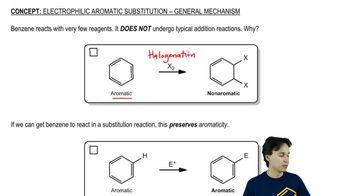
EAS Review

Aromaticity

Aromaticity refers to the special stability and reactivity of certain cyclic compounds that follow Huckel's rule, which states that a compound must have (4n + 2) π electrons to be considered aromatic. This property influences the positions on the ring that are susceptible to electrophilic attack, making it essential to identify which carbons can be nitrated.
추천 영상:
08:19
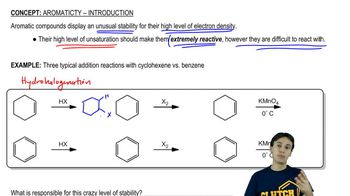
Intro to Aromaticity

Regioselectivity in Nitration

Regioselectivity in nitration describes the preference of the electrophile to attack specific positions on the aromatic ring, influenced by substituents already present. Electron-donating groups activate the ring and direct substitution to ortho and para positions, while electron-withdrawing groups direct it to the meta position, which is critical for predicting the outcome of the nitration reaction.
추천 영상:
06:09
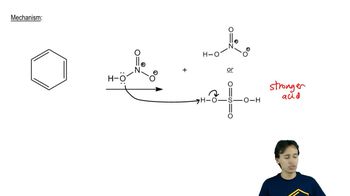
EAS Nitration