Ch. 18 - Reactions of Benzene and Substituted Benzenes
Bruice - Organic Chemistry 8th Edition
Bruice8th EditionOrganic ChemistryISBN: 9780135213711당신이 사용하는 게 아니라요?교과서 변경
18장, 문제 58a,b

For each of the following compounds, indicate the ring carbon(s) that is/are nitrated when the compound is treated with HNO3/H2SO4:
a.
b.

검증된 단계별 안내
1
Step 1: Analyze the substituents on the benzene ring for each compound. Substituents influence the reactivity and regioselectivity of electrophilic aromatic substitution reactions, such as nitration. Electron-withdrawing groups (e.g., NO2, COOH) are deactivating and direct incoming groups to meta positions, while electron-donating groups (e.g., alkoxy groups) are activating and direct to ortho/para positions.
Step 2: For compound (a), the benzene ring has two substituents: a nitro group (-NO2) and a carboxylic acid group (-COOH). Both are electron-withdrawing and deactivating, directing incoming electrophiles to the meta positions relative to themselves. Identify the meta positions relative to each substituent and determine overlap.
Step 3: For compound (b), the benzene ring has two ester groups (-COOCH3). Ester groups are electron-withdrawing through resonance and inductive effects, but they are less deactivating compared to nitro groups. They direct incoming electrophiles to the meta positions relative to themselves. Identify the meta positions relative to each ester group and determine overlap.
Step 4: Consider steric hindrance in both compounds. In compound (a), the nitro and carboxylic acid groups may create steric hindrance at certain positions, potentially affecting the likelihood of nitration at those sites. Similarly, in compound (b), the ester groups may influence steric accessibility of the meta positions.
Step 5: Summarize the positions on the benzene ring for each compound that are most likely to undergo nitration based on the electronic and steric effects of the substituents. These positions are determined by the directing effects of the substituents and the overlap of meta positions.

비슷한 문제에 대한 검증된 영상 답변:

이 영상 해법은 위 문제에 도움이 된다고 튜터들이 추천한 것입니다.
영상 길이:
4m

주요 개념

질문에 올바르게 답하기 위해 반드시 이해해야 하는 핵심 개념들은 다음과 같습니다.

Electrophilic Aromatic Substitution

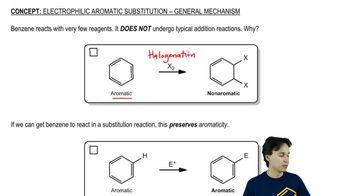
Electrophilic aromatic substitution (EAS) is a fundamental reaction in organic chemistry where an electrophile replaces a hydrogen atom on an aromatic ring. This process is crucial for understanding how substituents influence the reactivity of aromatic compounds. In the context of nitration, the electrophile is the nitronium ion (NO2+), generated from nitric acid and sulfuric acid, which attacks the electron-rich aromatic ring.
추천 영상:
03:07
EAS Review

Directing Effects of Substituents

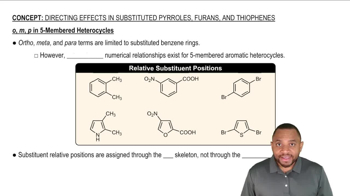
Substituents on an aromatic ring can either be electron-donating or electron-withdrawing, affecting the position where new substituents are added during EAS. Electron-donating groups (like -OH or -OCH3) direct incoming electrophiles to the ortho and para positions, while electron-withdrawing groups (like -NO2 or -CF3) direct them to the meta position. Understanding these directing effects is essential for predicting the outcome of nitration reactions.
추천 영상:
가이드 코스
2:02
Directing Effects in Substituted Pyrroles, Furans, and Thiophenes Concept 1

Nitration Mechanism

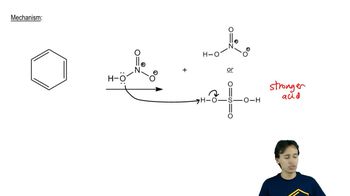
The nitration mechanism involves the generation of the nitronium ion, which acts as the electrophile in the reaction. The mechanism proceeds through the formation of a sigma complex (arenium ion) after the electrophile attacks the aromatic ring, followed by deprotonation to restore aromaticity. Recognizing this mechanism helps in identifying which carbon atoms in the ring will be nitrated based on the existing substituents.
추천 영상:
06:09
EAS Nitration