Ch. 18 - Reactions of Benzene and Substituted Benzenes
Bruice - Organic Chemistry 8th Edition
Bruice8th EditionOrganic ChemistryISBN: 9780135213711당신이 사용하는 게 아니라요?교과서 변경
18장, 문제 85b

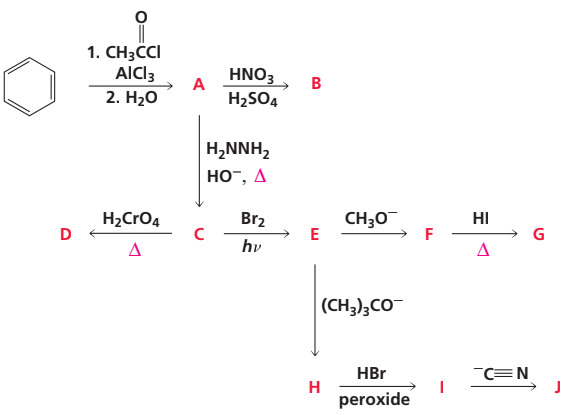
Identify A–J:

검증된 단계별 안내
1
Step 1: Analyze the first reaction. The starting compound is isopropylbenzene (cumene). It reacts with bromine (Br₂) under UV light (hν), which indicates a free radical halogenation reaction. The bromine will selectively replace a hydrogen atom at the benzylic position (the carbon adjacent to the benzene ring) due to the stability of the benzylic radical.
Step 2: The product of the first reaction (A) is a benzylic bromide. In the second step, this benzylic bromide reacts with tert-butoxide (tert-BuO⁻), a strong base. This is an elimination reaction (E2 mechanism), where the bromine is eliminated along with a proton from the adjacent carbon, forming a double bond. The product (B) is an alkene at the benzylic position.
Step 3: The third reaction involves the addition of hydrogen iodide (HI) to the alkene (B) under heat (Δ). This is an electrophilic addition reaction. HI adds across the double bond, following Markovnikov's rule, where the iodine attaches to the benzylic carbon and the hydrogen attaches to the less substituted carbon.
Step 4: The final product (C) is a benzylic iodide. This compound is formed as a result of the addition of HI to the alkene.
Step 5: To summarize, the sequence of reactions involves free radical halogenation, elimination, and electrophilic addition. Each step transforms the functional group at the benzylic position, leading to the final product.

비슷한 문제에 대한 검증된 영상 답변:

이 영상 해법은 위 문제에 도움이 된다고 튜터들이 추천한 것입니다.
영상 길이:
6m

주요 개념

질문에 올바르게 답하기 위해 반드시 이해해야 하는 핵심 개념들은 다음과 같습니다.

Radical Reactions

Radical reactions involve the formation and reaction of radicals, which are species with unpaired electrons. These reactions often require initiation steps, such as exposure to light (hv) or heat, to generate radicals from stable molecules. In this context, bromine (Br2) is used to generate a radical intermediate (A) through homolytic cleavage.
추천 영상:
03:49
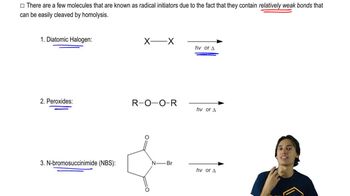
What are Radical Initiators?

Nucleophilic Substitution

Nucleophilic substitution is a fundamental reaction in organic chemistry where a nucleophile replaces a leaving group in a molecule. In the reaction sequence, the tert-butoxide ion (tert-BuO-) acts as a nucleophile, attacking the radical intermediate (A) to form compound B. This step is crucial for the transformation of radicals into more stable products.
추천 영상:
01:47
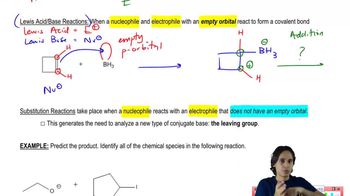
Nucleophiles and Electrophiles can react in Substitution Reactions.

Elimination Reactions

Elimination reactions involve the removal of atoms or groups from a molecule, resulting in the formation of a double bond or a ring structure. In this case, the reaction of compound B with hydrogen iodide (HI) under heat (Δ) leads to the elimination of a leaving group and the formation of compound C. Understanding elimination mechanisms is essential for predicting product formation in organic synthesis.
추천 영상:
00:40
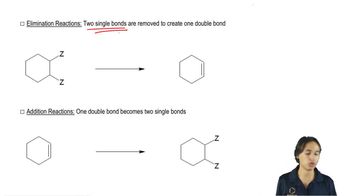
Recognizing Elimination Reactions.