Ch. 18 - Reactions of Benzene and Substituted Benzenes
Bruice - Organic Chemistry 8th Edition
Bruice8th EditionOrganic ChemistryISBN: 9780135213711당신이 사용하는 게 아니라요?교과서 변경
18장, 문제 85c

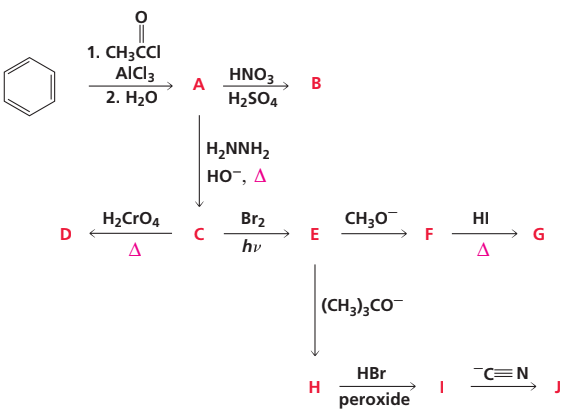
Identify A–J:
Diagram illustrating a series of radical reactions with labeled steps A to J, including chemical structures and reaction conditions.

검증된 단계별 안내
1
Step 1: Analyze the first reaction. The starting compound is an alkene with a phenyl group and an isopropenyl group. The reaction involves HBr in the presence of peroxide. This indicates an anti-Markovnikov addition of HBr due to the radical mechanism initiated by the peroxide.
Step 2: In the anti-Markovnikov addition, the bromine atom will add to the less substituted carbon of the double bond, while the hydrogen atom will add to the more substituted carbon. This results in the formation of compound A, which is a brominated alkane.
Step 3: Analyze the second reaction. Compound A reacts with NaCN. This is a nucleophilic substitution reaction (SN2 mechanism), where the bromine atom is replaced by the cyanide group (CN).
Step 4: The cyanide ion (CN⁻) acts as a nucleophile and attacks the carbon bonded to the bromine atom, displacing the bromine and forming compound B, which contains a nitrile group.
Step 5: Summarize the transformations. The first reaction converts the alkene into a brominated alkane (A) via anti-Markovnikov addition. The second reaction replaces the bromine in A with a nitrile group, forming compound B.

비슷한 문제에 대한 검증된 영상 답변:

이 영상 해법은 위 문제에 도움이 된다고 튜터들이 추천한 것입니다.
영상 길이:
4m

주요 개념

질문에 올바르게 답하기 위해 반드시 이해해야 하는 핵심 개념들은 다음과 같습니다.

Radical Reactions

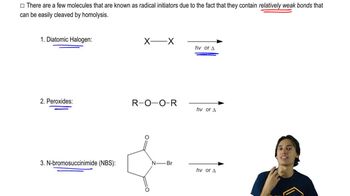
Radical reactions involve the formation and reaction of free radicals, which are highly reactive species with unpaired electrons. In the presence of peroxides, the addition of HBr to alkenes can lead to the formation of bromine radicals, which then add to the double bond, resulting in a product that can be further transformed. Understanding the mechanism of radical reactions is crucial for predicting the products of the reaction shown.
추천 영상:
03:49
What are Radical Initiators?

Markovnikov's Rule

Markovnikov's Rule states that in the addition of HX (where X is a halogen) to an alkene, the hydrogen atom will attach to the carbon with the greater number of hydrogen atoms already attached. This principle helps predict the regioselectivity of the reaction, guiding the formation of product A in the diagram. Recognizing this rule is essential for determining the structure of the intermediate or final products in reactions involving alkenes.
추천 영상:
03:54
The 18 and 16 Electron Rule

Nucleophilic Substitution

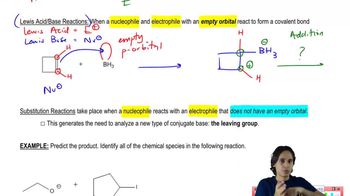
Nucleophilic substitution is a fundamental reaction mechanism in organic chemistry where a nucleophile replaces a leaving group in a molecule. In the context of the reaction from A to B, NaCN acts as a nucleophile that attacks the electrophilic carbon in product A, leading to the formation of product B. Understanding this mechanism is vital for predicting the outcome of the reaction and the nature of the final product.
추천 영상:
01:47
Nucleophiles and Electrophiles can react in Substitution Reactions.