Ch. 18 - Reactions of Benzene and Substituted Benzenes
Bruice - Organic Chemistry 8th Edition
Bruice8th EditionOrganic ChemistryISBN: 9780135213711당신이 사용하는 게 아니라요?교과서 변경
18장, 문제 52b

Show how the following compounds can be synthesized from benzene:
b. m-chloroethylbenzene

검증된 단계별 안내
1
Step 1: Begin with benzene as the starting material. Benzene is an aromatic compound with alternating double bonds in a six-membered ring.
Step 2: Perform a Friedel-Crafts alkylation reaction to introduce the ethyl group onto the benzene ring. Use ethyl chloride (C₂H₅Cl) and a Lewis acid catalyst such as AlCl₃. This reaction will yield ethylbenzene.
Step 3: Carry out a chlorination reaction to introduce a chlorine atom onto the benzene ring. Use Cl₂ and a catalyst such as FeCl₃. This reaction will produce a mixture of ortho-, meta-, and para-chloroethylbenzene.
Step 4: Separate the meta-chloroethylbenzene from the mixture using techniques such as fractional distillation or chromatography, as the meta-isomer is the desired product.
Step 5: Confirm the structure of the synthesized m-chloroethylbenzene using spectroscopic methods such as NMR or IR to ensure the correct substitution pattern on the benzene ring.

비슷한 문제에 대한 검증된 영상 답변:

이 영상 해법은 위 문제에 도움이 된다고 튜터들이 추천한 것입니다.
영상 길이:
7m

주요 개념

질문에 올바르게 답하기 위해 반드시 이해해야 하는 핵심 개념들은 다음과 같습니다.

Electrophilic Aromatic Substitution (EAS)

Electrophilic Aromatic Substitution is a fundamental reaction in organic chemistry where an electrophile replaces a hydrogen atom on an aromatic ring. This process is crucial for synthesizing various aromatic compounds, including m-chloroethylbenzene from benzene. The reaction typically involves the generation of a positively charged intermediate, which then loses a proton to restore aromaticity.
추천 영상:
03:07
EAS Review

Regioselectivity in Substitution Reactions

Regioselectivity refers to the preference of a chemical reaction to yield one structural isomer over others when multiple possibilities exist. In the case of m-chloroethylbenzene synthesis, understanding the directing effects of substituents on the benzene ring is essential. The presence of an ethyl group directs the incoming electrophile to the meta position relative to itself, leading to the desired product.
추천 영상:
01:34
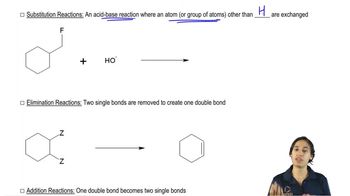
Recognizing Substitution Reactions.

Chlorination of Aromatic Compounds

Chlorination is a specific type of electrophilic aromatic substitution where chlorine is introduced into an aromatic compound. This reaction often requires a catalyst, such as iron(III) chloride, to generate the electrophilic chlorine species. In the synthesis of m-chloroethylbenzene, chlorination occurs after the ethyl group has been introduced, allowing for the selective formation of the meta product.
추천 영상:
08:19
Intro to Aromaticity