Ch. 20 - The Organic Chemistry of Carbohydrates
Bruice - Organic Chemistry 8th Edition
Bruice8th EditionOrganic ChemistryISBN: 9780135213711당신이 사용하는 게 아니라요?교과서 변경
20장, 문제 53

A D-aldopentose is oxidized by nitric acid to an optically active aldaric acid. A Wohl degradation of the aldopentose leads to a monosaccharide that is oxidized by nitric acid to an optically inactive aldaric acid. Identify the D-aldopentose.

검증된 단계별 안내
1
Step 1: Understand the problem. The d-aldopentose is oxidized by nitric acid to form an optically active aldaric acid. This means the aldaric acid has chiral centers and is not a meso compound. Additionally, performing a Wohl degradation on the aldopentose reduces its carbon chain by one, resulting in a monosaccharide that, when oxidized by nitric acid, forms an optically inactive aldaric acid (a meso compound).
Step 2: Recall the oxidation of aldoses by nitric acid. Nitric acid oxidizes both the aldehyde group at C-1 and the primary alcohol group at the terminal carbon (C-5 in a pentose) to carboxylic acids, forming an aldaric acid. For the aldaric acid to be optically active, it must have chiral centers and lack a plane of symmetry.
Step 3: Analyze the Wohl degradation. The Wohl degradation removes the C-1 carbon (the aldehyde group) of the aldopentose, resulting in an aldose with one fewer carbon atom. The resulting aldose is then oxidized by nitric acid to form an aldaric acid. For this aldaric acid to be optically inactive, it must be a meso compound, meaning it has a plane of symmetry.
Step 4: Identify the d-aldopentose. The d-aldopentose must satisfy both conditions: (1) its oxidation by nitric acid produces an optically active aldaric acid, and (2) after a Wohl degradation, the resulting aldose produces an optically inactive (meso) aldaric acid upon oxidation. Based on these criteria, the d-aldopentose is D-glucose, as its structure aligns with these oxidation and symmetry properties.
Step 5: Verify the solution. Confirm that the oxidation of D-glucose by nitric acid produces an optically active aldaric acid (D-glucaric acid) and that the Wohl degradation of D-glucose produces D-arabinose, which, when oxidized by nitric acid, forms an optically inactive (meso) aldaric acid (meso-arabinaric acid). This confirms the identification of the d-aldopentose as D-glucose.

비슷한 문제에 대한 검증된 영상 답변:

이 영상 해법은 위 문제에 도움이 된다고 튜터들이 추천한 것입니다.

주요 개념

질문에 올바르게 답하기 위해 반드시 이해해야 하는 핵심 개념들은 다음과 같습니다.

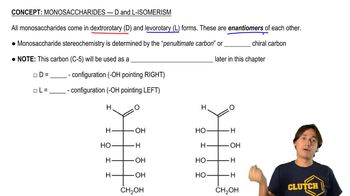
D-Aldopentose

A D-aldopentose is a five-carbon sugar (pentose) with an aldehyde group at one end and hydroxyl groups on the other carbons. The 'D' designation indicates the configuration of the sugar, specifically that the hydroxyl group on the penultimate carbon is on the right in a Fischer projection. Common examples include ribose and arabinose, which are important in biological systems.
추천 영상:
06:47
Monosaccharides - D and L Isomerism

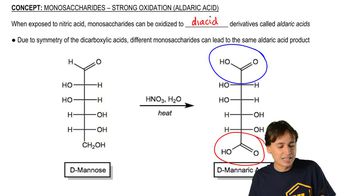
Aldaric Acid

Aldaric acid is a type of dicarboxylic acid formed from the oxidation of both the aldehyde and the primary alcohol groups of aldoses. This results in a compound with two carboxylic acid functional groups. The optical activity of aldaric acids can vary depending on the structure of the parent aldose, influencing their behavior in chemical reactions and interactions.
추천 영상:
03:10
Monosaccharides - Strong Oxidation (Aldaric Acid)

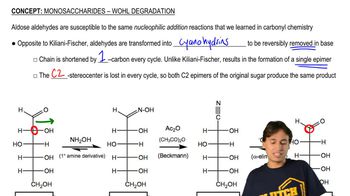
Wohl Degradation

Wohl degradation is a chemical reaction that involves the conversion of aldoses into monosaccharides by cleaving the carbon chain. This process typically results in the formation of a shorter-chain sugar and can lead to changes in optical activity. The reaction is significant in carbohydrate chemistry for determining the structure and properties of sugars.
추천 영상:
09:43
Monosaccharides - Wohl Degradation