Ch. 20 - The Organic Chemistry of Carbohydrates
Bruice - Organic Chemistry 8th Edition
Bruice8th EditionOrganic ChemistryISBN: 9780135213711당신이 사용하는 게 아니라요?교과서 변경
20장, 문제 59

The aldaric acid of D-glucose forms two five-membered-ring lactones. Draw their structures.

검증된 단계별 안내
1
Understand the problem: Aldaric acids are dicarboxylic acids derived from aldoses by oxidizing both the aldehyde group and the terminal primary alcohol group to carboxylic acids. For D-glucose, this means both the C1 and C6 carbons are oxidized to carboxylic acids. Lactones are cyclic esters formed when a hydroxyl group reacts with a carboxylic acid group within the same molecule.
Identify the functional groups in D-glucose: D-glucose has hydroxyl (-OH) groups on carbons C2, C3, C4, and C5. After oxidation to aldaric acid, the molecule will have carboxylic acid groups at C1 and C6, and hydroxyl groups at the other carbons.
Determine the possible lactone formations: A five-membered ring lactone (γ-lactone) forms when the hydroxyl group on C4 or C5 reacts with the carboxylic acid group on C1. This creates two possible structures depending on which hydroxyl group participates in the reaction.
Draw the first lactone structure: For the first lactone, the hydroxyl group on C4 reacts with the carboxylic acid group on C1. This forms a five-membered ring with the following atoms: C1 (carboxylic acid carbon), O (from the hydroxyl group on C4), C4, C3, and C2. The remaining hydroxyl groups and the carboxylic acid group on C6 remain unchanged.
Draw the second lactone structure: For the second lactone, the hydroxyl group on C5 reacts with the carboxylic acid group on C1. This forms a five-membered ring with the following atoms: C1 (carboxylic acid carbon), O (from the hydroxyl group on C5), C5, C4, and C3. The remaining hydroxyl groups and the carboxylic acid group on C6 remain unchanged.

비슷한 문제에 대한 검증된 영상 답변:

이 영상 해법은 위 문제에 도움이 된다고 튜터들이 추천한 것입니다.
영상 길이:
6m

주요 개념

질문에 올바르게 답하기 위해 반드시 이해해야 하는 핵심 개념들은 다음과 같습니다.

Aldaric Acid

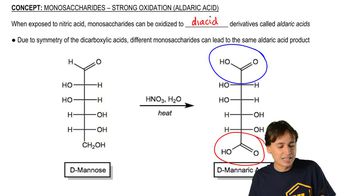
Aldaric acids are a type of dicarboxylic acid derived from aldoses, where both the aldehyde and the terminal alcohol group are oxidized to carboxylic acids. In the case of d-glucose, the aldaric acid formed is d-glucaric acid. Understanding the structure of aldaric acids is crucial for recognizing how they can undergo cyclization to form lactones.
추천 영상:
03:10
Monosaccharides - Strong Oxidation (Aldaric Acid)

Lactone Formation

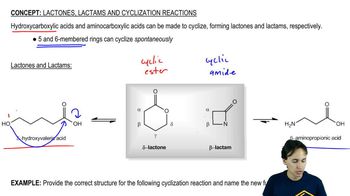
Lactones are cyclic esters formed when a hydroxyl group reacts with a carboxylic acid group within the same molecule, leading to the loss of water. In the case of d-glucose aldaric acid, two different five-membered lactones can be formed depending on which hydroxyl group participates in the reaction. This concept is essential for predicting the structures of the resulting lactones.
추천 영상:
05:19
Lactones and Lactams

Five-Membered Ring Structures

Five-membered ring structures, such as furanoses, are common in carbohydrate chemistry. They are formed when a sugar molecule cyclizes, creating a stable ring that can influence the molecule's reactivity and properties. Recognizing the formation of these rings from aldaric acids is key to drawing the correct structures of the lactones derived from d-glucose.
추천 영상:
05:14
Ring Expansion