Ch. 20 - The Organic Chemistry of Carbohydrates
Bruice - Organic Chemistry 8th Edition
Bruice8th EditionOrganic ChemistryISBN: 9780135213711당신이 사용하는 게 아니라요?교과서 변경
20장, 문제 22-23

When glucose undergoes base-catalyzed isomerization in the absence of the enzyme, mannose is one
of the products that is formed (Section 20.5). Why is mannose not formed in the enzyme-catalyzed reaction?

검증된 단계별 안내
1
Understand the process of base-catalyzed isomerization: In a base-catalyzed isomerization, glucose can undergo an enediol rearrangement, which allows it to convert into different isomers, such as mannose.
Recognize the role of enzymes in isomerization: Enzymes are highly specific catalysts that facilitate reactions by lowering the activation energy and stabilizing transition states. They often have specific active sites that only allow certain substrates to bind.
Identify the specificity of the enzyme involved: In the enzyme-catalyzed isomerization of glucose, the enzyme is specific to the conversion of glucose to fructose, not mannose. This specificity is due to the enzyme's active site, which is tailored to facilitate the conversion to fructose.
Consider the structural differences: Mannose and fructose have different structural arrangements. The enzyme's active site is designed to accommodate the transition state leading to fructose, not mannose.
Conclude why mannose is not formed: Due to the enzyme's specificity and the structural requirements of its active site, mannose is not formed in the enzyme-catalyzed reaction, as the enzyme does not facilitate the necessary rearrangement for mannose formation.

비슷한 문제에 대한 검증된 영상 답변:

이 영상 해법은 위 문제에 도움이 된다고 튜터들이 추천한 것입니다.
영상 길이:
4m

주요 개념

질문에 올바르게 답하기 위해 반드시 이해해야 하는 핵심 개념들은 다음과 같습니다.

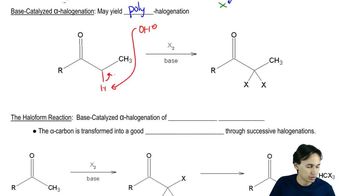
Base-Catalyzed Isomerization

Base-catalyzed isomerization involves the rearrangement of molecular structures through the action of a base, which facilitates the conversion of one isomer to another. In the case of glucose, the base can deprotonate hydroxyl groups, allowing for the formation of different structural isomers, such as mannose. This reaction typically occurs under non-enzymatic conditions, leading to a mixture of products.
추천 영상:
01:57
Base Catalyzed

Enzyme Specificity

Enzymes are biological catalysts that accelerate chemical reactions with high specificity for their substrates. In the case of glucose isomerization, enzymes like glucose isomerase preferentially convert glucose to fructose rather than mannose. This specificity arises from the enzyme's active site, which is shaped to fit certain substrates, thus preventing the formation of alternative products like mannose.
추천 영상:
03:
Specific Reactions - Allylic Chlorination

Reaction Mechanism

The reaction mechanism describes the step-by-step process by which reactants are converted into products. In enzyme-catalyzed reactions, the mechanism often involves multiple intermediates and specific transition states that are stabilized by the enzyme. Understanding the mechanism of glucose isomerization helps explain why mannose is not produced when the reaction is catalyzed by an enzyme, as the pathway diverges from that leading to mannose.
추천 영상:
02:16
Heck Reaction Mechanism