Ch. 20 - The Organic Chemistry of Carbohydrates
Bruice - Organic Chemistry 8th Edition
Bruice8th EditionOrganic ChemistryISBN: 9780135213711당신이 사용하는 게 아니라요?교과서 변경
20장, 문제 26

Why is only a trace amount of acid used in the formation of an N-glycoside?

검증된 단계별 안내
1
Understand the context: The formation of an N-glycoside involves the reaction of a sugar (typically in its cyclic hemiacetal form) with an amine. This reaction is acid-catalyzed, meaning a small amount of acid is used to facilitate the process.
Recognize the role of the acid: The acid protonates the hydroxyl group of the sugar, making it a better leaving group. This step is crucial for the formation of the oxocarbenium ion intermediate, which is highly reactive and facilitates the nucleophilic attack by the amine.
Consider the sensitivity of the reactants: Sugars are prone to degradation under strongly acidic conditions, such as hydrolysis or dehydration reactions. Using only a trace amount of acid minimizes the risk of side reactions and ensures the sugar remains intact during the reaction.
Acknowledge the catalytic nature of the acid: Since the acid is not consumed in the reaction, only a catalytic (trace) amount is needed to continuously facilitate the formation of the oxocarbenium ion and drive the reaction forward.
Conclude the reasoning: Using a trace amount of acid ensures that the reaction proceeds efficiently while avoiding excessive degradation of the sugar or other unwanted side reactions, leading to the selective formation of the N-glycoside.

비슷한 문제에 대한 검증된 영상 답변:

이 영상 해법은 위 문제에 도움이 된다고 튜터들이 추천한 것입니다.
영상 길이:
3m

주요 개념

질문에 올바르게 답하기 위해 반드시 이해해야 하는 핵심 개념들은 다음과 같습니다.

N-glycoside Formation

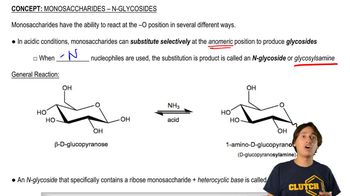
N-glycosides are formed when a sugar molecule reacts with an amine, resulting in a glycosidic bond. This reaction typically requires an acid catalyst to activate the sugar, making it more electrophilic and facilitating the nucleophilic attack by the amine. Understanding this process is crucial for grasping why specific conditions, such as the use of trace amounts of acid, are employed.
추천 영상:
04:31
General Reaction

Acid Catalysis

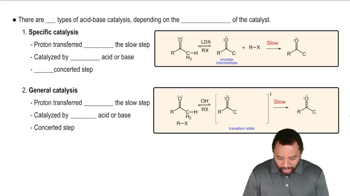
Acid catalysis involves the use of an acid to increase the rate of a chemical reaction. In the context of N-glycoside formation, a small amount of acid is sufficient to protonate the sugar, enhancing its reactivity without overwhelming the reaction. Excess acid can lead to side reactions or degradation of the sugar, making controlled use essential.
추천 영상:
가이드 코스
2:50
Acid-Base Catalysis Concept 3

Selectivity in Organic Reactions

Selectivity refers to the preference of a reaction to produce a particular product over others. In the formation of N-glycosides, using only a trace amount of acid helps ensure that the desired glycosidic bond forms preferentially, minimizing by-products. This selectivity is vital for achieving high yields and purity in organic synthesis.
추천 영상:
02:17
Identifying organic molecules