Ch. 28 - Pericyclic Reactions
Bruice - Organic Chemistry 8th Edition
Bruice8th EditionOrganic ChemistryISBN: 9780135213711당신이 사용하는 게 아니라요?교과서 변경
24장, 문제 28b

Draw the product formed when each of the following compounds undergoes an electrocyclic reaction
b. under photochemical conditions.
1.
2. Chemical structure of a conjugated system with a methyl group, indicating an electrocyclic reaction with an arrow pointing right.

검증된 단계별 안내
1
Step 1: Identify the type of reaction. The problem specifies an electrocyclic reaction under photochemical conditions. Electrocyclic reactions involve the conversion of a conjugated π-system into a cyclic structure or vice versa, depending on the number of π-electrons and the conditions (thermal or photochemical).
Step 2: Determine the electron count in the conjugated π-system. Both compounds shown are conjugated systems with 6 π-electrons. Under photochemical conditions, the reaction follows the Woodward-Hoffmann rules, which dictate that a 6 π-electron system undergoes a conrotatory ring closure.
Step 3: Apply the conrotatory mechanism. In a conrotatory process, the terminal groups of the conjugated system rotate in opposite directions (one clockwise and the other counterclockwise) to form the cyclic product. This rotation affects the stereochemistry of the substituents attached to the terminal carbons.
Step 4: Analyze the stereochemistry of the substituents. For the first compound, the two CH₃ groups are on opposite sides of the plane of the molecule. After conrotatory closure, the stereochemistry of the product will reflect this initial arrangement. Similarly, for the second compound, the CH₃ groups are on the same side of the plane, which will influence the stereochemistry of the cyclic product.
Step 5: Draw the cyclic product. The final product for each compound will be a cyclohexadiene structure with the substituents positioned according to the conrotatory mechanism and the initial stereochemistry of the reactants. Ensure the stereochemistry is consistent with the rules of the reaction.

비슷한 문제에 대한 검증된 영상 답변:

이 영상 해법은 위 문제에 도움이 된다고 튜터들이 추천한 것입니다.
영상 길이:
9m

주요 개념

질문에 올바르게 답하기 위해 반드시 이해해야 하는 핵심 개념들은 다음과 같습니다.

Electrocyclic Reactions

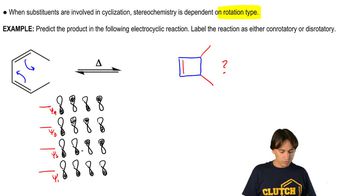
Electrocyclic reactions are a type of pericyclic reaction where a conjugated system undergoes a cyclic transformation, typically involving the formation or breaking of sigma bonds. These reactions can be influenced by thermal or photochemical conditions, leading to different products. Understanding the mechanism and the stereochemistry involved is crucial for predicting the outcome of these reactions.
추천 영상:
08:11
Predicting Electrocyclic Products

Photochemical Conditions

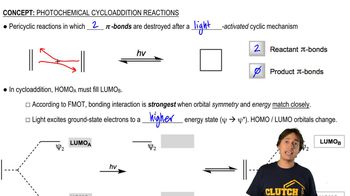
Photochemical conditions refer to reactions that are initiated or driven by light, particularly ultraviolet (UV) light. In electrocyclic reactions, these conditions can alter the stereochemical outcome compared to thermal conditions, often favoring the formation of different isomers. Recognizing how light energy affects molecular orbitals and reaction pathways is essential for predicting products.
추천 영상:
09:36
MO Theory of Photochemical Cycloadditions

Stereochemistry

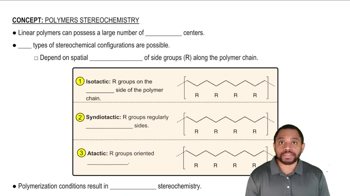
Stereochemistry is the study of the spatial arrangement of atoms in molecules and how this affects their chemical behavior. In electrocyclic reactions, the stereochemical outcome can vary significantly depending on whether the reaction occurs under thermal or photochemical conditions. Understanding concepts like conformation and chirality is vital for accurately drawing and predicting the products of these reactions.
추천 영상:
가이드 코스
1:38
Polymer Stereochemistry Concept 1