Ch. 28 - Pericyclic Reactions
Bruice - Organic Chemistry 8th Edition
Bruice8th EditionOrganic ChemistryISBN: 9780135213711당신이 사용하는 게 아니라요?교과서 변경
24장, 문제 32

What is the product of the following [1,3] sigmatropic rearrangement, A or B?
Chemical structure showing a [1,3] sigmatropic rearrangement with products labeled A and B.

검증된 단계별 안내
1
Step 1: Understand the concept of a [1,3] sigmatropic rearrangement. This is a pericyclic reaction where a sigma bond migrates along with the simultaneous reorganization of π-electrons. The numbers [1,3] indicate the positions of the atoms involved in the migration.
Step 2: Identify the starting material and locate the sigma bond that will migrate. Look for the bond adjacent to a π-system (such as a double bond or aromatic ring) that can participate in the rearrangement.
Step 3: Analyze the movement of electrons. Use curved arrows to show the breaking of the sigma bond and the formation of a new sigma bond at the [1,3] position. Ensure that the π-electrons are reorganized to maintain the stability of the system.
Step 4: Predict the product structure. After the rearrangement, verify the connectivity of the atoms and ensure that the new sigma bond is formed at the correct position. Compare the resulting structure to options A and B.
Step 5: Evaluate the stability of the products (A and B) if necessary. Consider factors such as resonance stabilization, steric hindrance, and electronic effects to determine which product is more likely to form.

비슷한 문제에 대한 검증된 영상 답변:

이 영상 해법은 위 문제에 도움이 된다고 튜터들이 추천한 것입니다.

주요 개념

질문에 올바르게 답하기 위해 반드시 이해해야 하는 핵심 개념들은 다음과 같습니다.

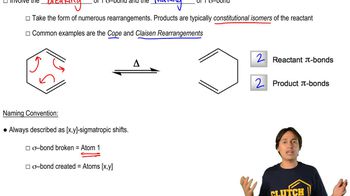
[1,3] Sigmatropic Rearrangement

[1,3] sigmatropic rearrangement is a type of pericyclic reaction where a sigma bond and a pi bond undergo a concerted rearrangement. In this process, a group migrates from one atom to another within a molecule, typically involving a shift of atoms or groups across a conjugated system. Understanding the mechanism and the stereochemistry involved is crucial for predicting the product of such reactions.
추천 영상:
03:20
Nomenclature of Sigmatropic Shifts

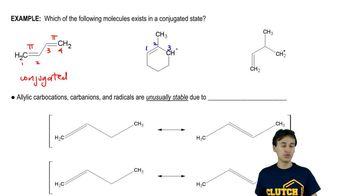
Conjugation

Conjugation refers to the overlap of p-orbitals across adjacent double bonds or lone pairs, leading to increased stability and delocalization of electrons. In the context of sigmatropic rearrangements, conjugation plays a significant role in stabilizing the transition state and influencing the regioselectivity of the reaction. Recognizing the conjugated systems involved helps in determining the favored product.
추천 영상:
03:27
Conjugated states

Regioselectivity

Regioselectivity is the preference of a chemical reaction to yield one structural isomer over others when multiple possibilities exist. In [1,3] sigmatropic rearrangements, the orientation of the migrating group can lead to different products, A or B. Analyzing the stability of the resulting isomers and the reaction conditions can help predict which product will be favored.
추천 영상:
05:09
Heck Reaction