Ch. 6 - The Reactions of Alkenes • The Stereochemistry of Addition Reactions
Bruice - Organic Chemistry 8th Edition
Bruice8th EditionOrganic ChemistryISBN: 9780135213711당신이 사용하는 게 아니라요?교과서 변경
6장, 문제 41(1)

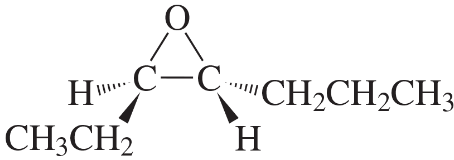
a. What alkene is required to synthesize each of the following compounds?
b. What other epoxide is formed in each synthesis?
c. Assign an R or S configuration to each asymmetric center.
1.

검증된 단계별 안내
1
Step 1: Analyze the given epoxide structure. The molecule contains a three-membered ring with an oxygen atom and two asymmetric centers. The substituents on the asymmetric centers are ethyl (CH3CH2), hydrogen (H), and butyl (CH2CH2CH3).
Step 2: Determine the alkene required for the synthesis of the epoxide. Epoxides are typically formed via the reaction of alkenes with peroxy acids (e.g., mCPBA). Identify the alkene by removing the oxygen atom and breaking the three-membered ring to form a double bond between the two carbon atoms.
Step 3: Consider regioselectivity and stereoselectivity. The stereochemistry of the epoxide suggests that the alkene used in the synthesis must have a specific geometry (cis or trans) to yield the observed stereochemistry. Analyze the substituents to deduce the correct alkene geometry.
Step 4: Identify the other epoxide that could be formed during the synthesis. Epoxidation of alkenes can lead to the formation of stereoisomers. Consider the possibility of forming the enantiomer of the given epoxide, which would have opposite configurations at the asymmetric centers.
Step 5: Assign R or S configurations to each asymmetric center. Use the Cahn-Ingold-Prelog priority rules to assign priorities to the substituents around each chiral center. Determine the configuration by analyzing the spatial arrangement of the substituents.

비슷한 문제에 대한 검증된 영상 답변:

이 영상 해법은 위 문제에 도움이 된다고 튜터들이 추천한 것입니다.
영상 길이:
2m

주요 개념

질문에 올바르게 답하기 위해 반드시 이해해야 하는 핵심 개념들은 다음과 같습니다.

Alkene Reactivity

Alkenes are hydrocarbons that contain at least one carbon-carbon double bond, making them reactive intermediates in organic synthesis. Their reactivity allows them to undergo various reactions, such as electrophilic addition, which is crucial for synthesizing complex molecules. Understanding the specific alkene required for a synthesis involves recognizing how the double bond can be manipulated to form desired products.
추천 영상:
가이드 코스
2:09
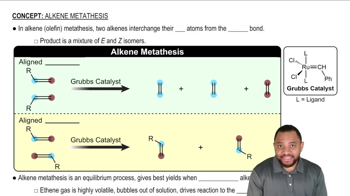
Alkene Metathesis Concept 1

Epoxide Formation

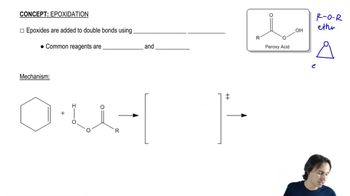
Epoxides are three-membered cyclic ethers formed from alkenes through reactions with peracids or halogenation followed by nucleophilic attack. They are important intermediates in organic synthesis due to their strained ring structure, which makes them highly reactive. Identifying the epoxide formed in a synthesis requires knowledge of the reaction conditions and the starting materials used.
추천 영상:
02:19
General properties of epoxidation.

Stereochemistry and R/S Configuration

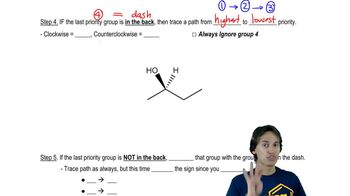
Stereochemistry is the study of the spatial arrangement of atoms in molecules and how this affects their chemical behavior. The R/S configuration system is used to assign absolute configurations to chiral centers based on the Cahn-Ingold-Prelog priority rules. Assigning R or S to asymmetric centers in a compound is essential for understanding its reactivity and interactions with other molecules, particularly in biological systems.
추천 영상:
03:07
R and S Naming- Step 4