Ch. 6 - The Reactions of Alkenes • The Stereochemistry of Addition Reactions
Bruice - Organic Chemistry 8th Edition
Bruice8th EditionOrganic ChemistryISBN: 9780135213711당신이 사용하는 게 아니라요?교과서 변경
6장, 문제 42d

What stereoisomers are obtained from hydroboration–oxidation of the following compounds? Assign an R or S configuration to each asymmetric center.
d. (Z)-3,4-dimethyl-3-hexene

검증된 단계별 안내
1
Analyze the structure of the given compound, (Z)-3,4-dimethyl-3-hexene. The (Z) configuration indicates that the higher-priority groups on either side of the double bond are on the same side. Draw the structure to visualize the stereochemistry of the starting material.
Understand the hydroboration–oxidation reaction. This reaction involves two steps: (1) addition of BH₃ (borane) to the double bond in an anti-Markovnikov manner, where the boron adds to the less substituted carbon, and (2) oxidation with H₂O₂/NaOH, replacing the boron with an -OH group. The reaction proceeds with syn addition, meaning both the hydrogen and the hydroxyl group add to the same face of the double bond.
Determine the stereochemistry of the product. Since the reaction is stereospecific and proceeds with syn addition, the two new substituents (H and OH) will be added to the same side of the double bond. This creates two new chiral centers at carbons 3 and 4 of the hexane chain.
Assign the R or S configuration to each chiral center. To do this, prioritize the groups attached to each chiral center based on the Cahn-Ingold-Prelog rules. Assign priorities (1 to 4) to the substituents, orient the lowest-priority group (usually hydrogen) away from you, and determine whether the sequence of priorities 1 → 2 → 3 is clockwise (R) or counterclockwise (S). Repeat this process for both chiral centers.
List all possible stereoisomers. Since two chiral centers are formed, there will be four possible stereoisomers (two pairs of enantiomers). However, the syn addition of hydroboration–oxidation limits the stereoisomers to a specific pair of enantiomers. Verify the configurations of the resulting stereoisomers and confirm their R or S designations for each chiral center.

비슷한 문제에 대한 검증된 영상 답변:

이 영상 해법은 위 문제에 도움이 된다고 튜터들이 추천한 것입니다.
영상 길이:
5m

주요 개념

질문에 올바르게 답하기 위해 반드시 이해해야 하는 핵심 개념들은 다음과 같습니다.

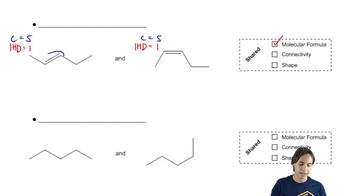
Stereoisomerism

Stereoisomerism refers to the phenomenon where compounds have the same molecular formula and connectivity of atoms but differ in the spatial arrangement of those atoms. This can lead to different physical and chemical properties. In organic chemistry, stereoisomers include enantiomers and diastereomers, which are crucial for understanding reactions like hydroboration-oxidation.
추천 영상:
01:58
Determining when molecules are stereoisomers.

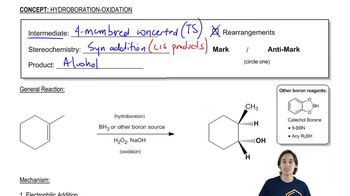
Hydroboration-Oxidation

Hydroboration-oxidation is a two-step reaction process used to convert alkenes into alcohols. The first step involves the addition of borane (BH3) to the alkene, resulting in a trialkylborane intermediate. The second step involves oxidation with hydrogen peroxide (H2O2) in a basic solution, leading to the formation of alcohols with anti-Markovnikov orientation, which is essential for determining the stereochemistry of the product.
추천 영상:
06:38
General properties of hydroboration-oxidation.

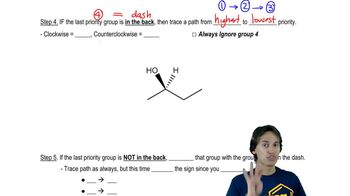
R and S Configuration

The R and S configuration system is used to describe the stereochemistry of chiral centers in molecules. To assign R or S, one must prioritize the substituents attached to the chiral carbon based on atomic number, then determine the orientation of the molecule. If the lowest priority group is oriented away from the viewer, the configuration is determined by the order of the remaining groups; clockwise is R and counterclockwise is S.
추천 영상:
03:07
R and S Naming- Step 4