Ch. 6 - The Reactions of Alkenes • The Stereochemistry of Addition Reactions
Bruice - Organic Chemistry 8th Edition
Bruice8th EditionOrganic ChemistryISBN: 9780135213711당신이 사용하는 게 아니라요?교과서 변경
6장, 문제 23c

Each of the following reactions has two nucleophiles that could add to the intermediate formed by the reaction of the alkene with an electrophile. What is the major product of each reaction?
c. Chemical reaction showing an alkene reacting with HCl and water, indicating the formation of a major product.

검증된 단계별 안내
1
Step 1: Analyze the reaction conditions. The reaction involves an alkene (CH3CH═CHCH3) reacting with HCl in the presence of water. This suggests an electrophilic addition mechanism where the alkene reacts with the electrophile (H+) from HCl.
Step 2: Identify the intermediate formed. The alkene undergoes protonation at the double bond, leading to the formation of a carbocation intermediate. The protonation occurs at the more substituted carbon to form the more stable carbocation (Markovnikov addition).
Step 3: Consider the nucleophiles present. In this reaction, there are two potential nucleophiles: Cl⁻ from HCl and H₂O from the aqueous environment. Both can attack the carbocation intermediate.
Step 4: Determine the major product. Water (H₂O) is a stronger nucleophile in the presence of dilute HCl and will preferentially attack the carbocation. This leads to the formation of an alcohol as the major product.
Step 5: Finalize the structure of the major product. After the nucleophilic attack by H₂O, a proton transfer occurs to stabilize the molecule, resulting in the formation of 2-butanol as the major product.

비슷한 문제에 대한 검증된 영상 답변:

이 영상 해법은 위 문제에 도움이 된다고 튜터들이 추천한 것입니다.
영상 길이:
6m

주요 개념

질문에 올바르게 답하기 위해 반드시 이해해야 하는 핵심 개념들은 다음과 같습니다.

Electrophilic Addition

Electrophilic addition is a fundamental reaction mechanism in organic chemistry where an electrophile reacts with a nucleophile, typically involving alkenes or alkynes. In this process, the double bond of the alkene acts as a nucleophile, attacking the electrophile, leading to the formation of a more stable carbocation intermediate. This mechanism is crucial for understanding how alkenes react with reagents like HCl.
추천 영상:
09:23
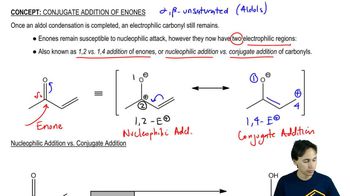
1,2 vs 1,4 Addition

Carbocation Stability

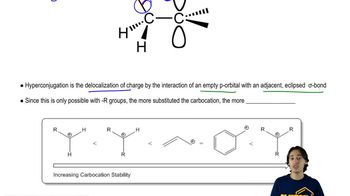
Carbocation stability is a key concept in organic chemistry that determines the outcome of reactions involving carbocations. The stability of a carbocation is influenced by factors such as the degree of substitution (primary, secondary, tertiary) and resonance effects. More stable carbocations are favored in reactions, as they are lower in energy and more likely to form, guiding the direction of nucleophilic attack in electrophilic addition reactions.
추천 영상:
05:58
Determining Carbocation Stability

Markovnikov's Rule

Markovnikov's Rule states that in the addition of HX (where X is a halogen) to an alkene, the hydrogen atom will attach to the carbon with the greater number of hydrogen atoms already attached. This rule helps predict the major product of electrophilic addition reactions, as it accounts for the formation of the more stable carbocation intermediate. Understanding this rule is essential for determining the major product in reactions like the one involving HCl and alkenes.
추천 영상:
03:54
The 18 and 16 Electron Rule