Ch. 6 - The Reactions of Alkenes • The Stereochemistry of Addition Reactions
Bruice - Organic Chemistry 8th Edition
Bruice8th EditionOrganic ChemistryISBN: 9780135213711당신이 사용하는 게 아니라요?교과서 변경
6장, 문제 25c,d

What will be the major product obtained from the reaction of Br2 with 1-butene if the reaction is carried out in
c. ethyl alcohol?
d. methyl alcohol?

검증된 단계별 안내
1
Identify the type of reaction: The reaction of Br2 with 1-butene in the presence of alcohol (ethyl alcohol or methyl alcohol) is an electrophilic addition reaction. The alcohol acts as a nucleophile in this case, leading to the formation of a bromohydrin.
Understand the mechanism: The reaction proceeds via the formation of a bromonium ion intermediate. The double bond in 1-butene reacts with Br2, forming a three-membered bromonium ion.
Determine the role of the alcohol: The alcohol (ethyl alcohol or methyl alcohol) acts as a nucleophile and attacks the more substituted carbon of the bromonium ion. This occurs because the more substituted carbon is better able to stabilize the partial positive charge.
Predict the regioselectivity: The nucleophilic attack by the alcohol will follow Markovnikov's rule, meaning the -OH group (from the alcohol) will attach to the more substituted carbon, while the bromine will attach to the less substituted carbon.
Write the product structure: For ethyl alcohol, the product will be 1-bromo-2-ethoxybutane. For methyl alcohol, the product will be 1-bromo-2-methoxybutane. These are the major products formed in each case.

비슷한 문제에 대한 검증된 영상 답변:

이 영상 해법은 위 문제에 도움이 된다고 튜터들이 추천한 것입니다.
영상 길이:
6m

주요 개념

질문에 올바르게 답하기 위해 반드시 이해해야 하는 핵심 개념들은 다음과 같습니다.

Electrophilic Addition

Electrophilic addition is a fundamental reaction mechanism in organic chemistry where an electrophile reacts with a nucleophile, typically involving alkenes. In the case of 1-butene reacting with Br2, the double bond acts as a nucleophile, attacking the electrophilic bromine molecule, leading to the formation of a bromonium ion intermediate. This step is crucial for understanding how the major product is formed.
추천 영상:
09:23
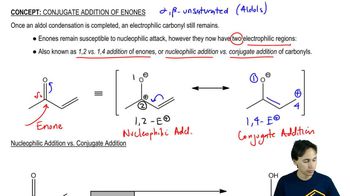
1,2 vs 1,4 Addition

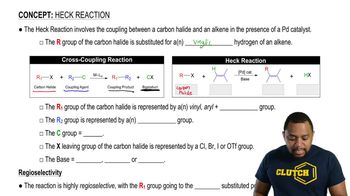
Regioselectivity

Regioselectivity refers to the preference of a chemical reaction to yield one structural isomer over others when multiple products are possible. In the reaction of Br2 with 1-butene, the regioselectivity is influenced by the stability of the carbocation intermediates formed during the reaction. Understanding regioselectivity helps predict the major product when the reaction is conducted in different solvents like ethyl or methyl alcohol.
추천 영상:
05:09
Heck Reaction

Solvent Effects

The choice of solvent can significantly influence the outcome of a chemical reaction, particularly in polar protic solvents like ethyl and methyl alcohol. These solvents can stabilize charged intermediates and influence the reaction pathway. In the case of the bromination of 1-butene, the solvent may affect the stability of the bromonium ion and the subsequent nucleophilic attack, leading to different major products depending on the solvent used.
추천 영상:
01:16
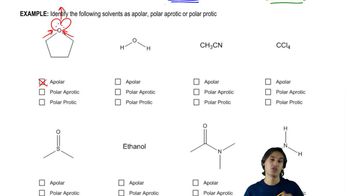
Identification of polarity in solvents