Ch. 6 - The Reactions of Alkenes • The Stereochemistry of Addition Reactions
Bruice - Organic Chemistry 8th Edition
Bruice8th EditionOrganic ChemistryISBN: 9780135213711당신이 사용하는 게 아니라요?교과서 변경
6장, 문제 57a

Identify the electrophile and the nucleophile in each of the following reaction steps and then draw curved arrows to illustrate the bond-making and bondbreaking processes.
a.

검증된 단계별 안내
1
Step 1: Identify the electrophile and nucleophile. The electrophile is the positively charged species, CH3CHCH3+, because it is electron-deficient and can accept electrons. The nucleophile is Cl−, as it has a lone pair of electrons and a negative charge, making it electron-rich and capable of donating electrons.
Step 2: Analyze the reaction mechanism. The nucleophile (Cl−) will attack the electrophile (CH3CHCH3+) to form a new bond. This involves the movement of electrons from the lone pair on Cl− to the positively charged carbon atom in CH3CHCH3+.
Step 3: Draw curved arrows to represent the bond-making process. The curved arrow should start from the lone pair of electrons on Cl− and point toward the positively charged carbon atom in CH3CHCH3+.
Step 4: Consider bond-breaking processes. In this reaction, no bonds are broken because the electrophile (CH3CHCH3+) is already prepared to accept the nucleophile without requiring the breaking of any existing bonds.
Step 5: Verify the product structure. The final product is CH3CHCH3 with Cl attached to the central carbon atom. Ensure that the formal charges are balanced and the octet rule is satisfied for all atoms in the product.

비슷한 문제에 대한 검증된 영상 답변:

이 영상 해법은 위 문제에 도움이 된다고 튜터들이 추천한 것입니다.
영상 길이:
2m

주요 개념

질문에 올바르게 답하기 위해 반드시 이해해야 하는 핵심 개념들은 다음과 같습니다.

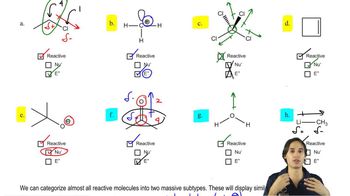
Electrophiles

Electrophiles are species that accept electrons during a chemical reaction. They are typically positively charged or neutral molecules with an electron-deficient atom, making them attractive to nucleophiles. In organic reactions, common electrophiles include carbocations, carbonyl compounds, and halogens. Understanding the nature of electrophiles is crucial for predicting reaction pathways and mechanisms.
추천 영상:
03:
Nucleophile or Electrophile

Nucleophiles

Nucleophiles are electron-rich species that donate electrons to electrophiles during a reaction. They can be negatively charged ions or neutral molecules with lone pairs of electrons. Common examples include hydroxide ions, alkoxides, and amines. Recognizing nucleophiles is essential for understanding how they interact with electrophiles to form new bonds in organic reactions.
추천 영상:
08:27
Nucleophilic Addition

Curved Arrows in Mechanisms

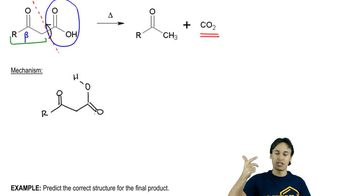
Curved arrows are used in organic chemistry to illustrate the movement of electrons during chemical reactions. A curved arrow starts from a nucleophile (where electrons are donated) and points to an electrophile (where electrons are accepted), indicating bond formation or breaking. This notation helps visualize reaction mechanisms and is fundamental for understanding how reactants transform into products.
추천 영상:
04:32
General Mechanism