Ch. 6 - The Reactions of Alkenes • The Stereochemistry of Addition Reactions
Bruice - Organic Chemistry 8th Edition
Bruice8th EditionOrganic ChemistryISBN: 9780135213711당신이 사용하는 게 아니라요?교과서 변경
6장, 문제 56a

Which electrophilic addition reactions
a. form a carbocation intermediate? intermediate?

검증된 단계별 안내
1
Understand the concept of electrophilic addition reactions: These reactions involve the addition of an electrophile (electron-deficient species) to a compound, typically an alkene or alkyne, which contains a π-bond. The π-bond acts as a nucleophile, attacking the electrophile.
Recognize that some electrophilic addition reactions proceed through a carbocation intermediate. A carbocation is a positively charged carbon species that forms when the π-bond breaks, and one of the carbon atoms temporarily loses its share of the bonding electrons.
Identify common electrophilic addition reactions that form carbocation intermediates. Examples include: (1) Hydrohalogenation (addition of HX, where X is a halogen), and (2) Acid-catalyzed hydration (addition of water in the presence of an acid).
Analyze the mechanism of these reactions: In hydrohalogenation, the π-bond attacks the proton (H⁺) from HX, forming a carbocation intermediate. Similarly, in acid-catalyzed hydration, the π-bond attacks the proton from the acid, leading to the formation of a carbocation intermediate.
Note that the stability of the carbocation intermediate plays a critical role in determining the regioselectivity of the reaction. For example, in hydrohalogenation, the more stable carbocation (e.g., tertiary > secondary > primary) will form preferentially due to hyperconjugation and inductive effects.

비슷한 문제에 대한 검증된 영상 답변:

이 영상 해법은 위 문제에 도움이 된다고 튜터들이 추천한 것입니다.
영상 길이:
3m

주요 개념

질문에 올바르게 답하기 위해 반드시 이해해야 하는 핵심 개념들은 다음과 같습니다.

Electrophilic Addition Reactions

Electrophilic addition reactions are a class of organic reactions where an electrophile reacts with a nucleophile, typically involving alkenes or alkynes. In these reactions, the double or triple bond is broken, allowing new atoms or groups to be added to the molecule. Understanding the mechanism of these reactions is crucial for predicting the products formed.
추천 영상:
05:39
Features of Addition Mechanisms.

Carbocation Intermediate

A carbocation intermediate is a positively charged species that contains a carbon atom with only six electrons in its valence shell, making it electron-deficient. Carbocations are often formed during electrophilic addition reactions when the electrophile attacks the nucleophile, leading to the formation of a temporary charged species. The stability of the carbocation can influence the reaction pathway and the final products.
추천 영상:
00:47
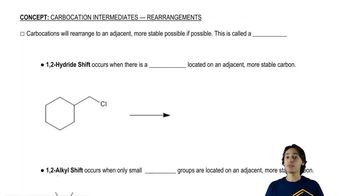
Understanding why carbocations shift.

Mechanism of Electrophilic Addition

The mechanism of electrophilic addition involves several steps, including the formation of a carbocation intermediate, nucleophilic attack, and deprotonation. The first step typically involves the electrophile attacking the alkene, resulting in the formation of a carbocation. Subsequent steps involve the nucleophile attacking the carbocation, leading to the final product. Understanding this mechanism is essential for predicting the outcomes of various electrophilic addition reactions.
추천 영상:
05:39
Features of Addition Mechanisms.