Ch. 6 - The Reactions of Alkenes • The Stereochemistry of Addition Reactions
Bruice - Organic Chemistry 8th Edition
Bruice8th EditionOrganic ChemistryISBN: 9780135213711당신이 사용하는 게 아니라요?교과서 변경
6장, 문제 58d

What is the major product of the reaction of 2-methyl-2-butene with each of the following reagents?
d. O3, −78 °C, followed by (CH3)2S

검증된 단계별 안내
1
Step 1: Recognize the reaction type. The reaction involves ozonolysis, which is a process where ozone (O3) cleaves the double bond of an alkene, breaking it into two carbonyl compounds (aldehydes or ketones). The second reagent, (CH3)2S (dimethyl sulfide), is a reducing agent that prevents the formation of carboxylic acids or further oxidation.
Step 2: Identify the structure of the starting material. The given compound is 2-methyl-2-butene, which is a branched alkene with the structure: CH3-C(CH3)=CH-CH3. The double bond is between the second and third carbon atoms.
Step 3: Predict the cleavage of the double bond. During ozonolysis, the double bond is cleaved, and each carbon atom of the double bond is converted into a carbonyl group. This means the molecule will split into two fragments, each containing a carbonyl group.
Step 4: Assign the resulting fragments. After cleavage, the two fragments are: (1) a ketone (CH3-C=O) from the more substituted carbon of the double bond, and (2) an aldehyde (CH3-CH2-CHO) from the less substituted carbon of the double bond. The reducing agent (CH3)2S ensures that the aldehyde remains in its reduced form and does not oxidize further.
Step 5: Combine the information to determine the major products. The major products of this reaction are acetone (CH3-C=O-CH3) and propanal (CH3-CH2-CHO), which result from the cleavage of the double bond in 2-methyl-2-butene followed by reduction with (CH3)2S.

비슷한 문제에 대한 검증된 영상 답변:

이 영상 해법은 위 문제에 도움이 된다고 튜터들이 추천한 것입니다.
영상 길이:
2m

주요 개념

질문에 올바르게 답하기 위해 반드시 이해해야 하는 핵심 개념들은 다음과 같습니다.

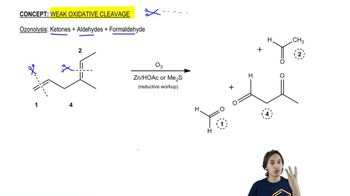
Ozonolysis

Ozonolysis is a reaction involving the cleavage of alkenes using ozone (O3) to form carbonyl compounds. In this process, the alkene reacts with ozone to form a molozonide, which rearranges to yield ozonides. These ozonides can then be reduced, typically with a reagent like dimethyl sulfide ((CH3)2S), to produce aldehydes or ketones, depending on the structure of the original alkene.
추천 영상:
06:30
General properties of ozonolysis.

Reactivity of Alkenes

Alkenes are hydrocarbons that contain at least one carbon-carbon double bond, making them reactive due to the presence of π bonds. The reactivity of alkenes allows them to undergo various addition reactions, including electrophilic additions and ozonolysis. The structure and substitution pattern of the alkene influence the stability of intermediates and the final products formed during these reactions.
추천 영상:
가이드 코스
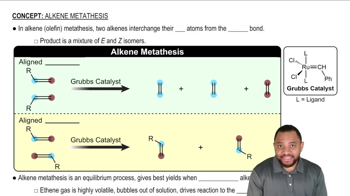
2:09
Alkene Metathesis Concept 1

Product Determination

Determining the major product of a reaction involves analyzing the stability of potential products and the mechanism of the reaction. In ozonolysis, the major products are typically the most stable carbonyl compounds formed from the cleavage of the double bond. Understanding the regioselectivity and stereochemistry of the reaction is crucial for predicting the correct major product.
추천 영상:
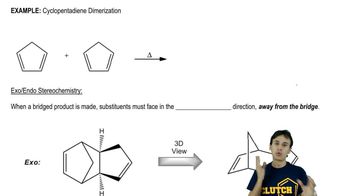
11:07
Bridged-Products