Ch. 7 - The Reactions of Alkynes • An Introduction to Multistep Synthesis
Bruice - Organic Chemistry 8th Edition
Bruice8th EditionOrganic ChemistryISBN: 9780135213711당신이 사용하는 게 아니라요?교과서 변경
7장, 문제 17a

For each of the following alkynes, draw the products obtained from (1) the acid-catalyzed addition of water (mercuric ion is added for part a) and from (2) hydroboration–oxidation:
a. 1-butyne 

검증된 단계별 안내
1
Step 1: Understand the reaction types. Acid-catalyzed hydration of alkynes involves the addition of water in the presence of an acid (H₂SO₄) and mercuric ion (Hg²⁺) as a catalyst. This reaction follows Markovnikov's rule and forms an enol intermediate, which tautomerizes to a ketone. Hydroboration-oxidation, on the other hand, involves the addition of BH₃ (or a borane derivative) followed by oxidation with H₂O₂/NaOH, leading to an anti-Markovnikov product, typically an aldehyde or ketone.
Step 2: For acid-catalyzed hydration of 1-butyne, identify the Markovnikov product. The water molecule adds across the triple bond such that the hydroxyl group (-OH) attaches to the more substituted carbon (C-2). This forms an enol intermediate, which undergoes keto-enol tautomerization to yield 2-butanone (a ketone).
Step 3: For hydroboration-oxidation of 1-butyne, identify the anti-Markovnikov product. The boron atom from BH₃ adds to the less substituted carbon (C-1) of the triple bond. After oxidation with H₂O₂/NaOH, the resulting product is an aldehyde, specifically butanal.
Step 4: Draw the structures of the intermediates and final products. For acid-catalyzed hydration, show the enol intermediate (CH₃-CH(OH)-CH=CH₂) and the final ketone product (CH₃-CO-CH₂-CH₃). For hydroboration-oxidation, show the intermediate organoborane and the final aldehyde product (CH₃-CH₂-CH₂-CHO).
Step 5: Verify the regioselectivity and stereochemistry of the products. Ensure that the acid-catalyzed hydration follows Markovnikov's rule and that the hydroboration-oxidation follows anti-Markovnikov's rule. Confirm that the products are consistent with the reaction mechanisms.

비슷한 문제에 대한 검증된 영상 답변:

이 영상 해법은 위 문제에 도움이 된다고 튜터들이 추천한 것입니다.
영상 길이:
4m

주요 개념

질문에 올바르게 답하기 위해 반드시 이해해야 하는 핵심 개념들은 다음과 같습니다.

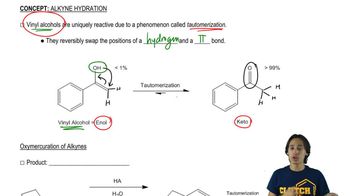
Acid-Catalyzed Hydration of Alkynes

In acid-catalyzed hydration, alkynes react with water in the presence of an acid catalyst, typically forming an enol that quickly tautomerizes to a ketone. For terminal alkynes like 1-butyne, the addition of water leads to the formation of a carbonyl compound, with the mercuric ion facilitating the reaction by stabilizing the carbocation intermediate.
추천 영상:
09:11
Alkyne Hydration

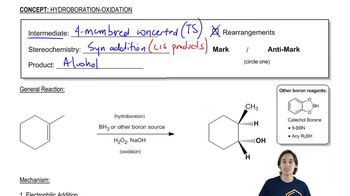
Hydroboration-Oxidation

Hydroboration-oxidation is a two-step reaction where an alkene or alkyne first reacts with diborane (B2H6) to form an organoborane intermediate, followed by oxidation with hydrogen peroxide (H2O2) in a basic solution. This method results in the anti-Markovnikov addition of water, leading to the formation of alcohols, which can be further converted to carbonyl compounds.
추천 영상:
06:38
General properties of hydroboration-oxidation.

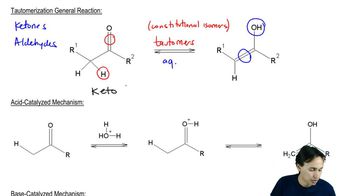
Tautomerization

Tautomerization is a chemical reaction that involves the rearrangement of bonds within a compound, typically resulting in the interconversion between an enol and a carbonyl compound (keto form). In the context of alkynes, after acid-catalyzed hydration, the enol form is often unstable and quickly converts to the more stable ketone, which is crucial for understanding the final products of the reaction.
추천 영상:
05:11
Tautomerization Mechanisms