Ch. 7 - The Reactions of Alkynes • An Introduction to Multistep Synthesis
Bruice - Organic Chemistry 8th Edition
Bruice8th EditionOrganic ChemistryISBN: 9780135213711당신이 사용하는 게 아니라요?교과서 변경
7장, 문제 14

What ketones are formed from the acid-catalyzed hydration of 3-heptyne?

검증된 단계별 안내
1
Step 1: Understand the reaction type. The acid-catalyzed hydration of an alkyne involves the addition of water (H₂O) across the triple bond in the presence of an acid catalyst, typically H₂SO₄, and often with Hg²⁺ as a co-catalyst. This reaction follows Markovnikov's rule and results in the formation of a ketone via an enol intermediate.
Step 2: Identify the structure of 3-heptyne. 3-heptyne is a seven-carbon alkyne with the triple bond located between carbons 3 and 4. Its structure can be written as CH₃-CH₂-C≡C-CH₂-CH₂-CH₃.
Step 3: Apply Markovnikov's rule. When water adds to the triple bond, the hydroxyl group (-OH) will attach to the more substituted carbon (C4 in this case), while the hydrogen (H) will attach to the less substituted carbon (C3). This results in the formation of an enol intermediate.
Step 4: Understand tautomerization. The enol intermediate (a compound with a hydroxyl group directly bonded to a carbon-carbon double bond) is not stable under acidic conditions. It undergoes keto-enol tautomerization, where the double bond shifts, and the hydroxyl group is converted into a carbonyl group (C=O), forming a ketone.
Step 5: Determine the product. The ketone formed will have the carbonyl group (C=O) on the more substituted carbon (C4). The final product is 4-heptanone, which is the ketone derived from the hydration of 3-heptyne.

비슷한 문제에 대한 검증된 영상 답변:

이 영상 해법은 위 문제에 도움이 된다고 튜터들이 추천한 것입니다.
영상 길이:
5m

주요 개념

질문에 올바르게 답하기 위해 반드시 이해해야 하는 핵심 개념들은 다음과 같습니다.

Acid-Catalyzed Hydration

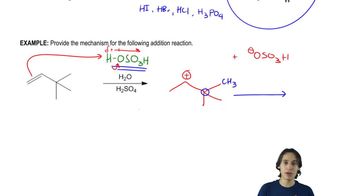
Acid-catalyzed hydration is a chemical reaction where an alkene or alkyne reacts with water in the presence of an acid catalyst, typically resulting in the formation of an alcohol. In the case of alkynes, this process involves the addition of water across the triple bond, leading to the formation of a carbonyl compound, such as a ketone, after rearrangement and tautomerization.
추천 영상:
06:34
Acid-catalyzed hydration mechanism

Alkyne Structure and Reactivity

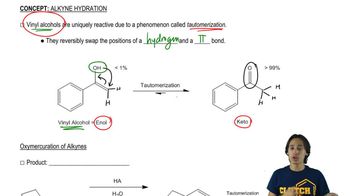
Alkynes are hydrocarbons that contain at least one carbon-carbon triple bond. The structure of 3-heptyne, specifically, indicates that it has a triple bond between the third and fourth carbon atoms in a seven-carbon chain. This unique structure influences its reactivity, allowing it to undergo hydration to form ketones, depending on the position of the triple bond and the conditions of the reaction.
추천 영상:
09:11
Alkyne Hydration

Tautomerization

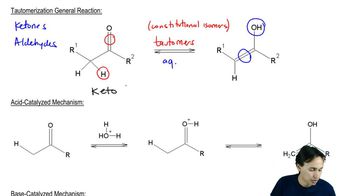
Tautomerization is a chemical process where a compound exists in two interconvertible forms, typically involving the migration of a hydrogen atom and a shift in the position of a double bond. In the context of the hydration of 3-heptyne, the initial product is an enol, which quickly tautomerizes to form a more stable ketone. Understanding this process is crucial for predicting the final products of the reaction.
추천 영상:
05:11
Tautomerization Mechanisms