Ch. 8 - Delocalized Electrons: Their Effect on Stability, pKa, and the Products of a Reaction • Aromaticity and Electronic Effects: An Introduction to the Reactions of Benzene
Bruice - Organic Chemistry 8th Edition
Bruice8th EditionOrganic ChemistryISBN: 9780135213711당신이 사용하는 게 아니라요?교과서 변경
8장, 문제 91

Draw the products obtained from the reaction of one equivalent of HBr with one equivalent of 1,3,5-hexatriene.
a. Which product(s) will predominate if the reaction is under kinetic control?
b. Which product(s) will predominate if the reaction is under thermodynamic control?

검증된 단계별 안내
1
Step 1: Recognize that 1,3,5-hexatriene is a conjugated triene, meaning it has alternating double and single bonds. The reaction with HBr involves electrophilic addition, where the H⁺ from HBr adds to one of the double bonds, generating a carbocation intermediate.
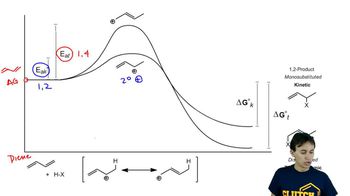
Step 2: Under kinetic control, the product distribution is determined by the rate of formation of intermediates. The most stable carbocation intermediate forms fastest. Identify the possible carbocation intermediates by protonating the double bonds and determine which is the most stable based on resonance and hyperconjugation.
Step 3: Under thermodynamic control, the product distribution is determined by the stability of the final products. Analyze the possible products formed by the addition of Br⁻ to the carbocation intermediates. The most stable product will predominate, which is typically the one with the most substituted double bond (Zaitsev's rule).
Step 4: Draw the structures of the products formed under both kinetic and thermodynamic control. For kinetic control, focus on the product derived from the most stable carbocation intermediate. For thermodynamic control, focus on the product with the most stable double bond configuration.
Step 5: Compare the products formed under kinetic and thermodynamic control. Highlight the differences in product distribution and explain how reaction conditions (e.g., temperature) influence whether the reaction is under kinetic or thermodynamic control.

비슷한 문제에 대한 검증된 영상 답변:

이 영상 해법은 위 문제에 도움이 된다고 튜터들이 추천한 것입니다.
영상 길이:
8m

주요 개념

질문에 올바르게 답하기 위해 반드시 이해해야 하는 핵심 개념들은 다음과 같습니다.

Electrophilic Addition Reactions

Electrophilic addition reactions involve the addition of an electrophile to a nucleophile, typically seen in alkenes and alkynes. In the case of 1,3,5-hexatriene reacting with HBr, the double bonds act as nucleophiles, attacking the electrophilic hydrogen in HBr. This reaction leads to the formation of bromoalkanes, with the regioselectivity influenced by the stability of the resulting carbocation.
추천 영상:
05:39
Features of Addition Mechanisms.

Kinetic vs. Thermodynamic Control

Kinetic control refers to conditions where the product distribution is determined by the rate of formation, favoring the more stable transition state and leading to the fastest-forming product. In contrast, thermodynamic control occurs when the product distribution is determined by the stability of the products themselves, favoring the more stable product over time. Understanding these concepts helps predict which product will dominate under different reaction conditions.
추천 영상:
08:51
Kinetic vs. Thermodynamic Control

Regioselectivity

Regioselectivity is the preference of a chemical reaction to yield one structural isomer over others when multiple products are possible. In the reaction of HBr with 1,3,5-hexatriene, the regioselectivity will depend on the stability of the carbocations formed during the reaction. More substituted carbocations are generally more stable, leading to the predominance of products that form from these intermediates under thermodynamic control.
추천 영상:
05:09
Heck Reaction