Ch. 8 - Delocalized Electrons: Their Effect on Stability, pKa, and the Products of a Reaction • Aromaticity and Electronic Effects: An Introduction to the Reactions of Benzene
Bruice - Organic Chemistry 8th Edition
Bruice8th EditionOrganic ChemistryISBN: 9780135213711당신이 사용하는 게 아니라요?교과서 변경
8장, 문제 92a

How would the following substituents affect the rate of a Diels–Alder reaction?
a. an electron-donating substituent in the diene

검증된 단계별 안내
1
Understand the Diels–Alder reaction: It is a [4+2] cycloaddition reaction between a conjugated diene and a dienophile. The reaction is facilitated by electron-rich dienes and electron-poor dienophiles.
Recognize the role of substituents: Substituents on the diene can influence the reaction rate by altering the electron density of the diene. Electron-donating groups (EDGs) increase the electron density of the diene, making it more reactive in the Diels–Alder reaction.
Identify common electron-donating groups: Examples of EDGs include -OH, -OR, -NH2, -NHR, -NR2, and alkyl groups. These groups donate electrons through resonance or inductive effects.
Explain the effect of an electron-donating substituent: An EDG on the diene stabilizes the transition state of the reaction by increasing the nucleophilicity of the diene. This enhances its ability to interact with the electron-deficient dienophile, thereby increasing the reaction rate.
Conclude the impact: The presence of an electron-donating substituent in the diene will accelerate the Diels–Alder reaction by making the diene more reactive toward the dienophile.

비슷한 문제에 대한 검증된 영상 답변:

이 영상 해법은 위 문제에 도움이 된다고 튜터들이 추천한 것입니다.
영상 길이:
6m

주요 개념

질문에 올바르게 답하기 위해 반드시 이해해야 하는 핵심 개념들은 다음과 같습니다.

Diels–Alder Reaction

The Diels–Alder reaction is a [4+2] cycloaddition between a conjugated diene and a dienophile, forming a six-membered ring. This reaction is a key method in organic synthesis for constructing cyclic compounds and is characterized by its stereospecificity and regioselectivity. Understanding the mechanism and the role of substituents is crucial for predicting the reaction's outcome.
추천 영상:
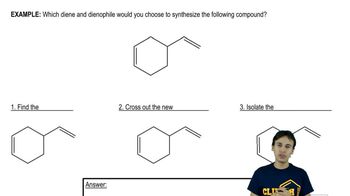
04:02
Diels-Alder Retrosynthesis

Electron-Donating Groups (EDGs)

Electron-donating groups are substituents that increase the electron density of the diene, typically through resonance or inductive effects. In the context of the Diels–Alder reaction, EDGs enhance the reactivity of the diene by stabilizing the transition state, leading to a faster reaction rate. Common examples include alkyl groups and methoxy groups.
추천 영상:
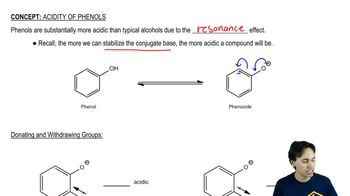
02:37
Donating vs Withdrawing Groups

Reaction Rate and Substituent Effects

The rate of a chemical reaction can be significantly influenced by the nature of substituents on the reactants. In the Diels–Alder reaction, substituents on the diene can either accelerate or decelerate the reaction depending on their electronic properties. Understanding how these substituents interact with the diene and dienophile is essential for predicting the reaction kinetics.
추천 영상:
가이드 코스
5:07
Rates of Intramolecular Reactions Concept 2