Ch. 9 - Substitution and Elimination Reactions of Alkyl Halides
Bruice - Organic Chemistry 8th Edition
Bruice8th EditionOrganic ChemistryISBN: 9780135213711당신이 사용하는 게 아니라요?교과서 변경
9장, 문제 66a

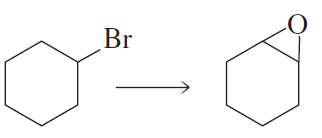
For each of the following target molecules, design a multistep synthesis to show how it can be prepared from the given starting material:
a. Chemical reaction diagram showing the conversion of a bromocyclohexane to a cyclohexanone.

검증된 단계별 안내
1
Step 1: Analyze the starting material and target molecule. The starting material is bromocyclopentane, and the target molecule is cyclopentanone. This transformation involves replacing the bromine atom with a carbonyl group (C=O).
Step 2: Perform a nucleophilic substitution reaction to replace the bromine atom with a hydroxyl group (-OH). Use aqueous hydroxide (e.g., NaOH or KOH) under appropriate conditions to achieve this substitution, forming cyclopentanol.
Step 3: Oxidize the cyclopentanol to cyclopentanone. Use an oxidizing agent such as PCC (Pyridinium Chlorochromate) or Jones reagent (CrO3/H2SO4) to convert the alcohol group (-OH) into a ketone group (C=O).
Step 4: Ensure the reaction conditions are controlled to avoid overoxidation or side reactions. For example, PCC is ideal for selective oxidation of primary and secondary alcohols to aldehydes or ketones.
Step 5: Verify the structure of the final product (cyclopentanone) using spectroscopic techniques such as IR (to confirm the presence of the C=O stretch) or NMR (to confirm the chemical environment of the protons and carbons).

비슷한 문제에 대한 검증된 영상 답변:

이 영상 해법은 위 문제에 도움이 된다고 튜터들이 추천한 것입니다.
영상 길이:
2m

주요 개념

질문에 올바르게 답하기 위해 반드시 이해해야 하는 핵심 개념들은 다음과 같습니다.

Nucleophilic Substitution

Nucleophilic substitution is a fundamental reaction in organic chemistry where a nucleophile attacks an electrophilic carbon atom, replacing a leaving group. In this case, the bromine atom in the brominated cyclohexane acts as a leaving group, allowing a nucleophile to take its place. Understanding this mechanism is crucial for designing a synthesis pathway that transforms the starting material into the desired cyclic ketone.
추천 영상:
01:47
Nucleophiles and Electrophiles can react in Substitution Reactions.

Cyclization Reactions

Cyclization reactions involve the formation of a ring structure from a linear or branched chain compound. In the context of the given question, the synthesis of the cyclic ketone from the brominated cyclohexane may involve intramolecular reactions that lead to the formation of a new ring. Recognizing the conditions and reagents that promote cyclization is essential for successfully completing the synthesis.
추천 영상:
01:33
Cyclization Reaction

Oxidation Reactions

Oxidation reactions in organic chemistry refer to the process of increasing the oxidation state of a molecule, often involving the addition of oxygen or the removal of hydrogen. In the transformation from the brominated cyclohexane to the cyclic ketone, an oxidation step may be necessary to convert an alcohol or another intermediate into the ketone. Familiarity with common oxidizing agents and their mechanisms is vital for planning the synthesis.
추천 영상:
03:20
Benzylic Oxidation