Ch. 9 - Substitution and Elimination Reactions of Alkyl Halides
Bruice - Organic Chemistry 8th Edition
Bruice8th EditionOrganic ChemistryISBN: 9780135213711당신이 사용하는 게 아니라요?교과서 변경
9장, 문제 66c

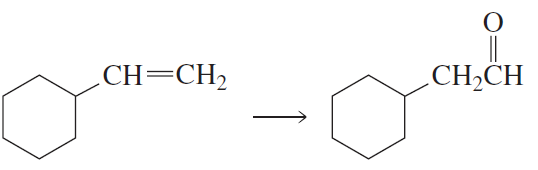
For each of the following target molecules, design a multistep synthesis to show how it can be prepared from the given starting material:
c. Chemical reaction diagram showing the conversion of an alkene to a ketone with a specific structure and reaction arrow.

검증된 단계별 안내
1
Step 1: Analyze the starting material and target molecule. The starting material is cyclopentylmethanol, and the target molecule is cyclopentylcarboxaldehyde. This transformation involves the oxidation of a primary alcohol to an aldehyde.
Step 2: Select an appropriate oxidizing agent for the transformation. To convert a primary alcohol to an aldehyde without overoxidation to a carboxylic acid, use reagents such as PCC (Pyridinium Chlorochromate) or DMP (Dess-Martin Periodinane).
Step 3: Set up the reaction conditions. Dissolve the starting material in a suitable solvent like dichloromethane (DCM) and add the oxidizing agent (e.g., PCC) under mild conditions to ensure selective oxidation to the aldehyde.
Step 4: Monitor the reaction progress. Use techniques like TLC (Thin Layer Chromatography) to confirm the conversion of the alcohol to the aldehyde. The aldehyde will typically show a distinct spot compared to the starting alcohol.
Step 5: Purify the product. After the reaction is complete, isolate the cyclopentylcarboxaldehyde by extraction and purification methods such as distillation or column chromatography.

비슷한 문제에 대한 검증된 영상 답변:

이 영상 해법은 위 문제에 도움이 된다고 튜터들이 추천한 것입니다.
영상 길이:
8m

주요 개념

질문에 올바르게 답하기 위해 반드시 이해해야 하는 핵심 개념들은 다음과 같습니다.

Alkynes and Alkylation

Alkynes are hydrocarbons containing at least one carbon-carbon triple bond. Alkylation is a reaction where an alkyl group is transferred to a nucleophile, often involving alkynes as intermediates. This process is crucial in organic synthesis for building complex molecules, as it allows for the introduction of carbon chains and functional groups.
추천 영상:
09:11
Alkyne Hydration

Stereochemistry

Stereochemistry is the study of the spatial arrangement of atoms in molecules and how this affects their chemical behavior. In multistep syntheses, understanding stereochemistry is essential for predicting the outcomes of reactions, especially when dealing with chiral centers or geometric isomers. Proper stereochemical considerations ensure the desired configuration of the target molecule is achieved.
추천 영상:
가이드 코스
1:38
Polymer Stereochemistry Concept 1

Functional Group Transformations

Functional group transformations involve converting one functional group into another through various chemical reactions. This concept is fundamental in organic synthesis, as it allows chemists to modify molecules to achieve desired properties or reactivity. Recognizing how to strategically change functional groups is key to designing effective synthetic pathways.
추천 영상:
02:36
Identifying Functional Groups