Ch. 9 - Substitution and Elimination Reactions of Alkyl Halides
Bruice - Organic Chemistry 8th Edition
Bruice8th EditionOrganic ChemistryISBN: 9780135213711당신이 사용하는 게 아니라요?교과서 변경
9장, 문제 10a,b

Indicate whether each of the following solvents is protic or aprotic:
a. chloroform (CHCl3)
b. diethyl ether

검증된 단계별 안내
1
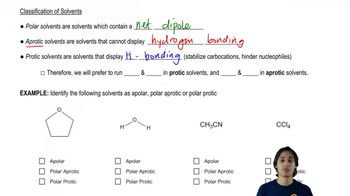
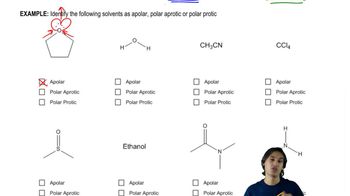
Step 1: Understand the difference between protic and aprotic solvents. Protic solvents have hydrogen atoms bonded to electronegative atoms (like oxygen or nitrogen), which can participate in hydrogen bonding. Aprotic solvents lack such hydrogen atoms and cannot form hydrogen bonds.
Step 2: Analyze chloroform (CHCl₃). Chloroform contains hydrogen atoms bonded to carbon, not to an electronegative atom like oxygen or nitrogen. Therefore, it cannot participate in hydrogen bonding and is classified as an aprotic solvent.
Step 3: Analyze diethyl ether (C₂H₅OC₂H₅). Diethyl ether has oxygen atoms, but the hydrogens in the molecule are bonded to carbon atoms, not to the oxygen. Since it cannot form hydrogen bonds, it is also classified as an aprotic solvent.
Step 4: Summarize the findings: Both chloroform and diethyl ether are aprotic solvents because neither contains hydrogen atoms bonded to electronegative atoms capable of hydrogen bonding.
Step 5: Apply this concept to other solvents by checking for the presence of hydrogen atoms bonded to electronegative atoms (protic) or their absence (aprotic).

비슷한 문제에 대한 검증된 영상 답변:

이 영상 해법은 위 문제에 도움이 된다고 튜터들이 추천한 것입니다.
영상 길이:
3m

주요 개념

질문에 올바르게 답하기 위해 반드시 이해해야 하는 핵심 개념들은 다음과 같습니다.

Protic Solvents

Protic solvents are those that have a hydrogen atom attached to an electronegative atom, typically oxygen or nitrogen, allowing them to form hydrogen bonds. This characteristic enables protic solvents to donate protons (H+) in chemical reactions, which is crucial for understanding their reactivity and solvation properties. Common examples include water and alcohols.
추천 영상:
03:57
The difference between protic vs. aprotic solvents.

Aprotic Solvents

Aprotic solvents lack hydrogen atoms bonded to electronegative atoms, meaning they cannot donate protons. These solvents can still solvate ions and molecules but do so through dipole interactions rather than hydrogen bonding. Examples include acetone and dimethyl sulfoxide (DMSO), which are often used in reactions where protic solvents would interfere.
추천 영상:
03:57
The difference between protic vs. aprotic solvents.

Solvent Polarity

The polarity of a solvent is determined by its molecular structure and the distribution of electrical charge. Polar solvents, which include many protic solvents, can stabilize ions and polar molecules, while nonpolar or aprotic solvents are better suited for dissolving nonpolar substances. Understanding solvent polarity is essential for predicting solubility and reactivity in organic reactions.
추천 영상:
01:16
Identification of polarity in solvents