Ch. 9 - Substitution and Elimination Reactions of Alkyl Halides
Bruice - Organic Chemistry 8th Edition
Bruice8th EditionOrganic ChemistryISBN: 9780135213711당신이 사용하는 게 아니라요?교과서 변경
9장, 문제 10c,d

Indicate whether each of the following solvents is protic or aprotic:
c. acetic acid
d. hexane

검증된 단계별 안내
1
Step 1: Understand the difference between protic and aprotic solvents. Protic solvents have hydrogen atoms bound to electronegative atoms (like oxygen or nitrogen) that can participate in hydrogen bonding. Aprotic solvents lack such hydrogen atoms and cannot form hydrogen bonds.
Step 2: Analyze acetic acid (CH₃COOH). Acetic acid contains a hydroxyl (-OH) group attached to a carbonyl group. The hydrogen in the hydroxyl group is bound to oxygen, an electronegative atom, making acetic acid a protic solvent.
Step 3: Analyze hexane (C₆H₁₄). Hexane is a hydrocarbon composed entirely of carbon and hydrogen atoms. It does not contain any electronegative atoms like oxygen or nitrogen, nor does it have hydrogen atoms capable of forming hydrogen bonds. Therefore, hexane is an aprotic solvent.
Step 4: Summarize the findings: Acetic acid is a protic solvent because it has a hydroxyl group capable of hydrogen bonding. Hexane is an aprotic solvent because it lacks electronegative atoms and hydrogen bonding capability.
Step 5: Apply this understanding to other solvents in future problems by identifying functional groups and determining whether hydrogen bonding is possible.

비슷한 문제에 대한 검증된 영상 답변:

이 영상 해법은 위 문제에 도움이 된다고 튜터들이 추천한 것입니다.
영상 길이:
2m

주요 개념

질문에 올바르게 답하기 위해 반드시 이해해야 하는 핵심 개념들은 다음과 같습니다.

Protic Solvents

Protic solvents are those that have a hydrogen atom attached to an electronegative atom, typically oxygen or nitrogen, allowing them to form hydrogen bonds. This characteristic enables protic solvents to donate protons (H+) in chemical reactions, which is crucial in many organic reactions, particularly those involving nucleophiles and electrophiles.
추천 영상:
03:57
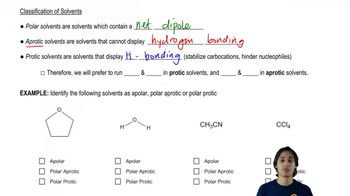
The difference between protic vs. aprotic solvents.

Aprotic Solvents

Aprotic solvents lack hydrogen atoms bonded to electronegative atoms, meaning they cannot donate protons. These solvents can still solvate ions and molecules but do not participate in hydrogen bonding. Aprotic solvents are often used in reactions where strong nucleophiles are required, as they do not hinder nucleophilic attack.
추천 영상:
03:57
The difference between protic vs. aprotic solvents.

Solvent Properties in Organic Chemistry

The choice of solvent in organic chemistry significantly affects reaction mechanisms and outcomes. Protic and aprotic solvents influence the solubility of reactants, the stability of intermediates, and the overall reaction rate. Understanding the properties of solvents helps chemists select the appropriate medium for specific reactions, optimizing yields and selectivity.
추천 영상:
03:57
The difference between protic vs. aprotic solvents.