Ch. 9 - Substitution and Elimination Reactions of Alkyl Halides
Bruice - Organic Chemistry 8th Edition
Bruice8th EditionOrganic ChemistryISBN: 9780135213711당신이 사용하는 게 아니라요?교과서 변경
9장, 문제 67d

What product is formed when 1-bromopropane reacts with each of the following nucleophiles?
d. HS−

검증된 단계별 안내
1
Step 1: Recognize the type of reaction. This is a nucleophilic substitution reaction where 1-bromopropane (an alkyl halide) reacts with HS⁻ (a nucleophile). Since 1-bromopropane is a primary alkyl halide, the reaction is likely to proceed via the SN2 mechanism.
Step 2: Understand the SN2 mechanism. In an SN2 reaction, the nucleophile attacks the electrophilic carbon (the carbon bonded to the bromine) directly from the opposite side of the leaving group, resulting in a single-step reaction.
Step 3: Identify the leaving group. Bromine (Br⁻) is the leaving group in this reaction. It will detach from the carbon atom as the nucleophile (HS⁻) forms a new bond with the carbon.
Step 4: Write the chemical equation for the reaction. The nucleophile HS⁻ attacks the carbon bonded to bromine in 1-bromopropane, displacing the bromine atom. The product formed will be propylthiol (CH₃CH₂CH₂SH).
Step 5: Consider stereochemistry. Since the SN2 mechanism involves a backside attack, if the carbon bonded to bromine were chiral, the product would exhibit inversion of configuration. However, in this case, 1-bromopropane does not have a chiral center, so stereochemistry is not a concern.

비슷한 문제에 대한 검증된 영상 답변:

이 영상 해법은 위 문제에 도움이 된다고 튜터들이 추천한 것입니다.
영상 길이:
4m

주요 개념

질문에 올바르게 답하기 위해 반드시 이해해야 하는 핵심 개념들은 다음과 같습니다.

Nucleophilic Substitution

Nucleophilic substitution is a fundamental reaction in organic chemistry where a nucleophile attacks an electrophile, resulting in the replacement of a leaving group. In the case of 1-bromopropane, the bromine atom acts as the leaving group, and the nucleophile (HS−) replaces it, forming a new product. Understanding this mechanism is crucial for predicting the outcome of the reaction.
추천 영상:
01:47
Nucleophiles and Electrophiles can react in Substitution Reactions.

Nucleophiles

Nucleophiles are species that donate an electron pair to form a chemical bond in a reaction. They are typically negatively charged or neutral molecules with lone pairs of electrons. In this question, HS− is a strong nucleophile due to its negative charge and ability to readily attack electrophilic centers, such as the carbon atom bonded to the bromine in 1-bromopropane.
추천 영상:
08:27
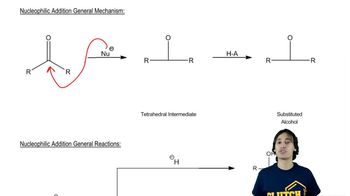
Nucleophilic Addition

Reaction Mechanism

The reaction mechanism describes the step-by-step process by which reactants are converted into products. For the reaction of 1-bromopropane with HS−, the mechanism can involve either an SN1 or SN2 pathway, depending on the conditions. Understanding these mechanisms helps predict the structure of the product formed, which in this case would be propanethiol (HS-CH2-CH2-CH3).
추천 영상:
02:16
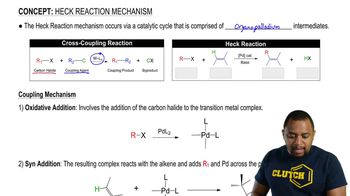
Heck Reaction Mechanism