

Ch. 9 - Substitution and Elimination Reactions of Alkyl Halides
Bruice - Organic Chemistry 8th Edition
Bruice8th EditionOrganic ChemistryISBN: 9780135213711당신이 사용하는 게 아니라요?교과서 변경
9장, 문제 125

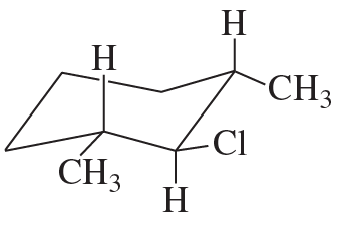
What products are formed when the following stereoisomer of 2-chloro-1,3-dimethylcyclohexane reacts with methoxide ion?
Stereoisomer structure of 2-chloro-1,3-dimethylcyclohexane with labeled hydrogen and chlorine atoms.

검증된 단계별 안내
1
Identify the type of reaction: The reaction involves a strong base (methoxide ion, CH₃O⁻) and an alkyl halide (2-chloro-1,3-dimethylcyclohexane). This suggests that the reaction could proceed via an elimination (E2) mechanism or a substitution (SN2) mechanism. Analyze the conditions to determine the dominant pathway.
Examine the structure of the substrate: 2-chloro-1,3-dimethylcyclohexane is a cyclohexane ring with a chlorine atom and two methyl groups attached. Determine the stereochemistry of the molecule (e.g., axial or equatorial positions of the substituents) to predict the reaction outcome.
Consider the E2 elimination mechanism: In an E2 reaction, the base abstracts a proton from a β-carbon (a carbon adjacent to the carbon bearing the leaving group). The leaving group (Cl⁻) departs simultaneously, forming a double bond. Identify the β-hydrogens that are anti-periplanar (in opposite planes) to the leaving group, as this geometry is required for E2 elimination.
Evaluate the possibility of SN2 substitution: In an SN2 reaction, the methoxide ion would attack the carbon bearing the chlorine atom, displacing the Cl⁻ group in a single step. However, steric hindrance from the cyclohexane ring and the methyl groups may make SN2 less favorable. Assess whether steric hindrance is significant in this case.
Predict the products: For the E2 pathway, determine the most stable alkene product based on Zaitsev's rule (the more substituted alkene is generally favored). For the SN2 pathway, predict the substitution product where methoxide replaces the chlorine atom. Consider the stereochemical outcomes for both pathways.

비슷한 문제에 대한 검증된 영상 답변:

이 영상 해법은 위 문제에 도움이 된다고 튜터들이 추천한 것입니다.
영상 길이:
1m

주요 개념

질문에 올바르게 답하기 위해 반드시 이해해야 하는 핵심 개념들은 다음과 같습니다.

Stereoisomerism

Stereoisomerism refers to the phenomenon where compounds have the same molecular formula and connectivity of atoms but differ in the spatial arrangement of their atoms. In the case of 2-chloro-1,3-dimethylcyclohexane, the specific stereochemistry (cis or trans) affects how the molecule interacts with reagents, influencing the reaction pathway and products formed.
추천 영상:
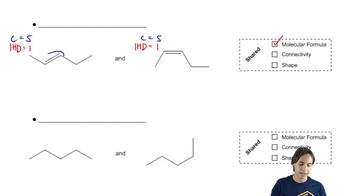
01:58
Determining when molecules are stereoisomers.

Nucleophilic Substitution Reactions

Nucleophilic substitution reactions involve the replacement of a leaving group (like a chloride ion) by a nucleophile (such as methoxide ion). The mechanism can proceed via either an SN1 or SN2 pathway, depending on factors like steric hindrance and the nature of the substrate. Understanding these mechanisms is crucial for predicting the products of the reaction.
추천 영상:
01:47
Nucleophiles and Electrophiles can react in Substitution Reactions.

Cyclohexane Conformation

Cyclohexane can adopt various conformations, primarily chair and boat forms, which influence the reactivity of substituents on the ring. The stability of these conformations affects how substituents are positioned relative to each other, impacting the outcome of reactions, especially in stereospecific reactions involving nucleophiles.
추천 영상:
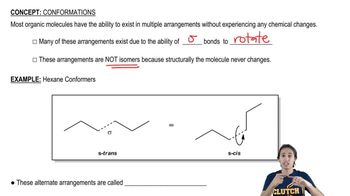
03:29
Understanding what a conformer is.