


Ch. 9 - Substitution and Elimination Reactions of Alkyl Halides
Bruice - Organic Chemistry 8th Edition
Bruice8th EditionOrganic ChemistryISBN: 9780135213711당신이 사용하는 게 아니라요?교과서 변경
9장, 문제 124a

Propose a mechanism for the following reaction.

검증된 단계별 안내
1
Step 1: Analyze the reactants and products. The starting material is a dibrominated ether, and the reaction involves methanol (CH₃OH) as a nucleophile. The products show substitution of one bromine atom with a methoxy group (-OCH₃) in two different positions, indicating a nucleophilic substitution reaction.
Step 2: Identify the mechanism type. This reaction likely proceeds via an SN2 mechanism because the bromine atoms are attached to a secondary carbon, which is sterically accessible for nucleophilic attack. Methanol acts as the nucleophile, attacking the carbon bonded to bromine.
Step 3: Describe the first substitution step. Methanol donates its lone pair of electrons to the carbon bonded to bromine, forming a transition state. Simultaneously, the bromine atom leaves as a bromide ion (Br⁻), resulting in the formation of the first product with a methoxy group replacing one bromine atom.
Step 4: Explain the second substitution step. The same process occurs at the other bromine-substituted carbon. Methanol attacks the carbon, displacing the bromine atom and forming the second product with a methoxy group replacing the bromine atom at the other position.
Step 5: Consider stereochemistry. Since the reaction involves an SN2 mechanism, the nucleophilic attack results in inversion of configuration at the carbon centers where substitution occurs. This explains the stereochemical differences observed in the products.

비슷한 문제에 대한 검증된 영상 답변:

이 영상 해법은 위 문제에 도움이 된다고 튜터들이 추천한 것입니다.
영상 길이:
5m

주요 개념

질문에 올바르게 답하기 위해 반드시 이해해야 하는 핵심 개념들은 다음과 같습니다.

Reaction Mechanism

A reaction mechanism is a step-by-step description of how a chemical reaction occurs at the molecular level. It outlines the sequence of elementary steps, including bond breaking and formation, and the intermediates formed during the reaction. Understanding the mechanism helps predict the products and the conditions under which the reaction occurs.
추천 영상:
02:16
Heck Reaction Mechanism

Nucleophiles and Electrophiles

Nucleophiles are species that donate an electron pair to form a chemical bond, while electrophiles are electron-deficient species that accept an electron pair. Identifying these species in a reaction is crucial for proposing a mechanism, as it determines the direction of electron flow and the nature of the reaction pathway.
추천 영상:
03:
Nucleophile or Electrophile

Transition States and Intermediates

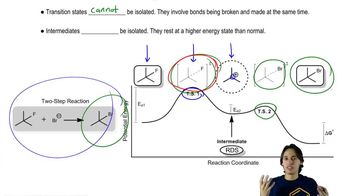
Transition states are high-energy states that occur during the transformation from reactants to products, representing the point of maximum energy along the reaction pathway. Intermediates are species that are formed and consumed during the reaction but are not present in the final products. Understanding these concepts is essential for accurately depicting the mechanism and energy changes involved.
추천 영상:
06:55
Intermediates vs. Transition States