Ch. 9 - Substitution and Elimination Reactions of Alkyl Halides
Bruice - Organic Chemistry 8th Edition
Bruice8th EditionOrganic ChemistryISBN: 9780135213711당신이 사용하는 게 아니라요?교과서 변경
9장, 문제 86a

Which species in each pair is more stable?
a. Comparison of two alkene structures: CH3CHCH2CH3 and CH3CH2CH2CH.

검증된 단계별 안내
1
Step 1: Analyze the molecular structure of each species. The first species, CH3C−HCH2CH3, contains a tertiary carbon (a carbon bonded to three other carbons) with a hydrogen attached. The second species, CH3CH2CH2C−H2, contains a primary carbon (a carbon bonded to only one other carbon) with two hydrogens attached.
Step 2: Consider the concept of carbocation stability. Tertiary carbons are generally more stable than primary carbons due to hyperconjugation and inductive effects. Hyperconjugation involves the delocalization of electrons from adjacent C-H bonds, while inductive effects involve electron donation from alkyl groups.
Step 3: Evaluate the stability of the hydrogen atoms attached to the carbon. In the first species, the hydrogen is bonded to a tertiary carbon, which is more stable due to the surrounding alkyl groups. In the second species, the hydrogens are bonded to a primary carbon, which is less stable.
Step 4: Consider steric hindrance. The first species has more steric hindrance due to the bulky groups around the tertiary carbon, but this does not significantly affect the stability of the hydrogen bond compared to the electronic effects.
Step 5: Conclude that the species with the hydrogen attached to the tertiary carbon (CH3C−HCH2CH3) is more stable than the species with hydrogens attached to the primary carbon (CH3CH2CH2C−H2), based on electronic effects such as hyperconjugation and inductive stabilization.

비슷한 문제에 대한 검증된 영상 답변:

이 영상 해법은 위 문제에 도움이 된다고 튜터들이 추천한 것입니다.
영상 길이:
5m

주요 개념

질문에 올바르게 답하기 위해 반드시 이해해야 하는 핵심 개념들은 다음과 같습니다.

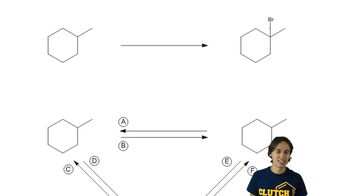
Stability of Alkanes

The stability of alkanes is influenced by factors such as steric hindrance and hyperconjugation. Generally, branched alkanes are more stable than their straight-chain counterparts due to reduced steric strain and increased hyperconjugation, which allows for better distribution of electron density.
추천 영상:
02:47
Functionalizing Alkanes

Hyperconjugation

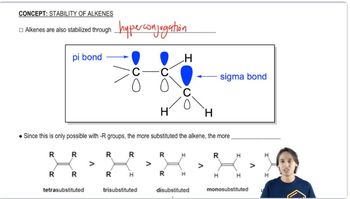
Hyperconjugation is a stabilizing interaction that occurs when the electrons in a sigma bond (usually C-H or C-C) interact with an adjacent empty or partially filled p-orbital or π-bond. This interaction helps to delocalize electron density, thereby increasing the stability of the molecule.
추천 영상:
04:28
Understanding trends of alkene stability.

Steric Hindrance

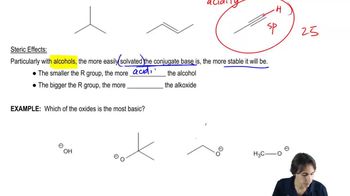
Steric hindrance refers to the repulsion between bulky groups within a molecule, which can affect its stability. In alkanes, increased branching reduces steric hindrance, leading to a more stable structure compared to linear forms, where atoms are more closely packed and experience greater repulsion.
추천 영상:
02:53
Understanding steric effects.