Ch. 9 - Substitution and Elimination Reactions of Alkyl Halides
Bruice - Organic Chemistry 8th Edition
Bruice8th EditionOrganic ChemistryISBN: 9780135213711당신이 사용하는 게 아니라요?교과서 변경
9장, 문제 86e

Which species in each pair is more stable?
e. Comparison of two carbocation structures to determine which is more stable.

검증된 단계별 안내
1
Step 1: Understand the concept of carbocation stability. Carbocations are positively charged carbon species, and their stability is influenced by factors such as hyperconjugation, resonance, and inductive effects. More stable carbocations are better stabilized by these factors.
Step 2: Analyze the first pair (C+H2CH2CH═CH2 vs. CH3C+HCH═CH2). For C+H2CH2CH═CH2, the carbocation is located on a primary carbon, and there is no resonance stabilization. For CH3C+HCH═CH2, the carbocation is located on a secondary carbon, and it can be stabilized by resonance with the adjacent double bond.
Step 3: Apply resonance stabilization to CH3C+HCH═CH2. The positive charge on the secondary carbon can delocalize into the π-electrons of the double bond, forming resonance structures. This delocalization increases the stability of the carbocation.
Step 4: Compare the stability of the two species in the first pair. CH3C+HCH═CH2 is more stable due to resonance stabilization and the fact that it is a secondary carbocation, which is inherently more stable than a primary carbocation.
Step 5: For part g, additional information is needed to analyze the stability of the species. If you provide the missing details, I can guide you through the solution effectively.

비슷한 문제에 대한 검증된 영상 답변:

이 영상 해법은 위 문제에 도움이 된다고 튜터들이 추천한 것입니다.
영상 길이:
5m

주요 개념

질문에 올바르게 답하기 위해 반드시 이해해야 하는 핵심 개념들은 다음과 같습니다.

Carbocation Stability

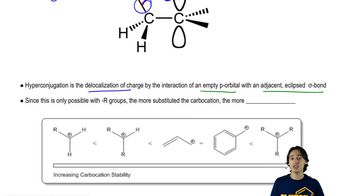
Carbocation stability is influenced by the degree of substitution and the presence of electron-donating groups. Tertiary carbocations are more stable than secondary, which are more stable than primary due to hyperconjugation and inductive effects. In the given pairs, analyzing the structure and substitution of the carbocations helps determine which is more stable.
추천 영상:
05:58
Determining Carbocation Stability

Resonance Effects

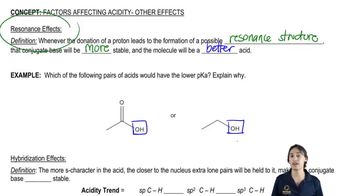
Resonance refers to the delocalization of electrons across adjacent bonds, which can stabilize a molecule. Carbocations can be stabilized by resonance if they are adjacent to double bonds or lone pairs. This effect can significantly influence the stability of the carbocations in the question, as resonance can distribute the positive charge over a larger area.
추천 영상:
03:32
Understanding Resonance Effects

Hybridization and Geometry

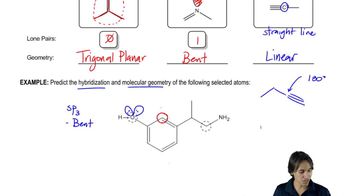
The hybridization of the carbon atom bearing the positive charge affects the stability of carbocations. sp2 hybridized carbocations (trigonal planar geometry) are generally more stable than sp3 hybridized ones (tetrahedral geometry) due to better orbital overlap and less steric strain. Understanding the hybridization of the carbons in the given structures is crucial for assessing their stability.
추천 영상:
01:54
Predict the hybridization and molecular geometry