Ch. 11 - Properties and Synthesis of Alkyl Halides: Radical Reactions
Mullins - Organic Chemistry: A Learner Centered Approach 1st Edition
Mullins1st EditionOrganic Chemistry: A Learner Centered ApproachISBN: 9780137566471당신이 사용하는 게 아니라요?교과서 변경
10장, 문제 15

A radical reaction, as it progressed through its propagation steps, involved the following radical species. Suggest which products might form in all possible termination steps (six products are possible).

검증된 단계별 안내
1
Identify the radical species involved in the reaction. In the image, we have a tin radical (Sn·) and a bromine radical (Br·), as well as an ethyl radical (·CH2CH3).
Understand that in a radical termination step, two radicals combine to form a stable molecule. This process removes radicals from the reaction mixture.
Consider all possible pairings of the radicals to form stable products. The radicals can pair as follows: Sn· with Br·, Sn· with ·CH2CH3, and Br· with ·CH2CH3.
For each pairing, draw the resulting molecule. For example, when Sn· and Br· combine, they form an organotin bromide compound.
Repeat the process for all possible combinations, ensuring that each radical is paired with every other radical at least once. This will result in six possible termination products.

비슷한 문제에 대한 검증된 영상 답변:

이 영상 해법은 위 문제에 도움이 된다고 튜터들이 추천한 것입니다.

주요 개념

질문에 올바르게 답하기 위해 반드시 이해해야 하는 핵심 개념들은 다음과 같습니다.

Radical Reaction Mechanism

Radical reactions involve species with unpaired electrons, known as radicals. These reactions typically proceed through three stages: initiation, propagation, and termination. In the termination step, radicals combine to form stable products, ceasing the radical chain process. Understanding these stages is crucial for predicting possible products in radical reactions.
추천 영상:
12:11
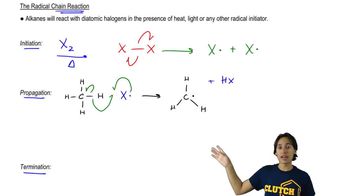
Radical Chain Reaction Mechanism.

Termination Steps in Radical Reactions

Termination steps occur when two radical species combine to form a stable, non-radical product. This step is essential in radical reactions as it determines the final products formed. In the given image, radicals such as Sn· and Br· can combine in various ways, leading to different termination products, which are crucial for understanding the reaction's outcome.
추천 영상:
12:11
Radical Chain Reaction Mechanism.

Radical Stability and Reactivity

Radical stability is influenced by factors such as the presence of electron-donating groups and the type of atom bearing the radical. More stable radicals are less reactive, affecting the likelihood of certain termination products. In the image, the stability of Sn· and Br· radicals will guide which combinations are more favorable, impacting the prediction of possible products.
추천 영상:
03:43
The radical stability trend.