Ch. 11 - Properties and Synthesis of Alkyl Halides: Radical Reactions
Mullins - Organic Chemistry: A Learner Centered Approach 1st Edition
Mullins1st EditionOrganic Chemistry: A Learner Centered ApproachISBN: 9780137566471당신이 사용하는 게 아니라요?교과서 변경
10장, 문제 11

Specify the conditions that would allow the synthesis of the 1° and 3° bromoalkanes from the same starting alkene.
Alkene reacts to form two bromoalkane diastereomers under conditions (a) and (b), showing hydrohalogenation pathways.

검증된 단계별 안내
1
Identify the starting alkene structure. Determine if it is symmetrical or asymmetrical, as this will influence the regioselectivity of the addition reactions.
For the synthesis of 1° bromoalkane, consider using hydroboration-oxidation followed by halogenation. Hydroboration-oxidation will convert the alkene into an alcohol, which can then be converted into a bromoalkane using PBr₃ or HBr.
For the synthesis of 3° bromoalkane, use Markovnikov addition of HBr to the alkene. This reaction proceeds via a carbocation intermediate, where the bromine will add to the more substituted carbon, resulting in a 3° bromoalkane.
Ensure that the reaction conditions for each synthesis are optimized. For hydroboration-oxidation, use BH₃ and THF followed by H₂O₂ and NaOH. For Markovnikov addition, use HBr in the presence of a peroxide to avoid anti-Markovnikov addition.
Consider stereochemistry and any potential rearrangements during the reactions. For example, carbocation rearrangements can occur during Markovnikov addition, potentially affecting the final product distribution.

비슷한 문제에 대한 검증된 영상 답변:

이 영상 해법은 위 문제에 도움이 된다고 튜터들이 추천한 것입니다.
영상 길이:
1m

주요 개념

질문에 올바르게 답하기 위해 반드시 이해해야 하는 핵심 개념들은 다음과 같습니다.

Markovnikov's Rule

Markovnikov's Rule predicts the regiochemistry of electrophilic addition reactions to alkenes, stating that the hydrogen atom will attach to the less substituted carbon, while the halide will attach to the more substituted carbon. This rule is crucial for understanding how 3° bromoalkanes can be synthesized from alkenes.
추천 영상:
03:54
The 18 and 16 Electron Rule

Anti-Markovnikov Addition

Anti-Markovnikov addition occurs when the halide attaches to the less substituted carbon of the alkene, often facilitated by radical initiators like peroxides. This concept is essential for synthesizing 1° bromoalkanes, as it allows the bromine to add to the terminal carbon of the alkene.
추천 영상:
02:43
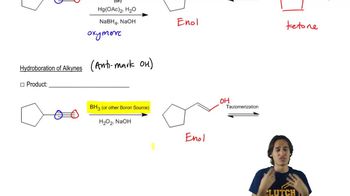
Anti-Markovnikov addition of alcohols to terminal alkynes yields aldehydes

Radical Mechanism

Radical mechanisms involve the formation of free radicals, which are highly reactive species with unpaired electrons. In the context of bromination, radicals can initiate anti-Markovnikov addition, enabling the formation of 1° bromoalkanes from alkenes under specific conditions, such as the presence of peroxides.
추천 영상:
03:28
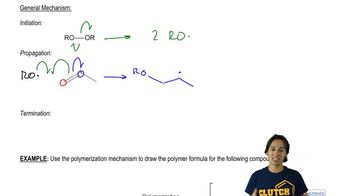
The mechanism of Radical Polymerization.