
교과서 질문
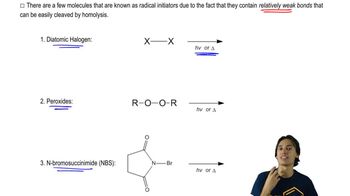
Tributyltin hydride (Bu3SnH) is often used as a 'radical carrier' in radical reactions. Which bond would you expect to be weaker, Sn–H or C–H? How might this relate to radical stability? Explain your answer.
946
views


 검증된 단계별 안내

 03:49

 12:58
 2:10
Tributyltin hydride (Bu3SnH) is often used as a 'radical carrier' in radical reactions. Which bond would you expect to be weaker, Sn–H or C–H? How might this relate to radical stability? Explain your answer.
Haloalkanes can be reduced to alkanes using radical reactions involving Bu₃SnH and a catalytic amount of AIBN. Suggest a mechanism for this reaction. [Pay close attention to the bonds formed and broken in developing your mechanism.]
A halogenation intended to make compound A formed B instead.
(c) Given the two mechanisms you drew, why might B have formed selectively?
Other molecules can be used as initiators in radical reactions. One such molecule is 2, 2'-azobisisobutyronitrile (AIBN). Show an arrow-pushing mechanism that rationalizes the formation of the following radical species. What are the driving forces of this reaction?
A halogenation intended to make compound A formed B instead.
(a) Suggest a mechanism for the intended formation of A.
A halogenation intended to make compound A formed B instead.
(b) Suggest a mechanism that rationalizes the formation of B.