Ch. 11 - Properties and Synthesis of Alkyl Halides: Radical Reactions
Mullins - Organic Chemistry: A Learner Centered Approach 1st Edition
Mullins1st EditionOrganic Chemistry: A Learner Centered ApproachISBN: 9780137566471당신이 사용하는 게 아니라요?교과서 변경
10장, 문제 40d

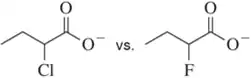
In each pair, choose the most basic compound. Justify your answer.
(d) Chemical structures comparing a chlorine-substituted compound and a fluorine-substituted compound, highlighting acidity differences.

검증된 단계별 안내
1
Step 1: Understand the concept of basicity. Basicity in organic chemistry refers to the ability of a compound to donate a pair of electrons to accept a proton (H⁺). The stronger the ability to donate electrons, the more basic the compound.
Step 2: Identify the functional groups in the compounds provided in the pair. Functional groups such as amines (R-NH₂) are typically more basic due to the lone pair of electrons on nitrogen, while groups like alcohols (R-OH) or carboxylic acids (R-COOH) are less basic.
Step 3: Consider the electronic effects. Electron-donating groups increase basicity by stabilizing the positive charge formed after protonation, while electron-withdrawing groups decrease basicity by destabilizing the protonated form.
Step 4: Evaluate the steric effects. Bulky substituents near the basic site can hinder protonation, reducing basicity.
Step 5: Compare the compounds in the pair based on the above factors (functional groups, electronic effects, and steric effects) and determine which compound is more basic. Justify your choice using these principles.

비슷한 문제에 대한 검증된 영상 답변:

이 영상 해법은 위 문제에 도움이 된다고 튜터들이 추천한 것입니다.
영상 길이:
4m

주요 개념

질문에 올바르게 답하기 위해 반드시 이해해야 하는 핵심 개념들은 다음과 같습니다.

Basic Compounds

Basic compounds are substances that can accept protons (H+) or donate electron pairs in chemical reactions. In organic chemistry, they often contain functional groups such as amines or alcohols that exhibit basic properties. Understanding the basicity of compounds is crucial for determining their reactivity and interactions with acids.
추천 영상:
01:40
Defining meso compounds.

Functional Groups

Functional groups are specific groups of atoms within molecules that are responsible for the characteristic chemical reactions of those molecules. Common functional groups include hydroxyl (-OH), carboxyl (-COOH), and amino (-NH2) groups. Identifying functional groups helps in predicting the behavior of organic compounds and their classification as acids, bases, or neutral substances.
추천 영상:
02:36
Identifying Functional Groups

Acid-Base Theory

Acid-base theory explains the behavior of acids and bases in terms of proton transfer. According to the Brønsted-Lowry theory, acids are proton donors, while bases are proton acceptors. This concept is essential for comparing compounds in terms of their acidity or basicity, which aids in determining which compound is more basic in a given pair.
추천 영상:
02:49
The Lewis definition of acids and bases.