Ch. 11 - Properties and Synthesis of Alkyl Halides: Radical Reactions
Mullins - Organic Chemistry: A Learner Centered Approach 1st Edition
Mullins1st EditionOrganic Chemistry: A Learner Centered ApproachISBN: 9780137566471당신이 사용하는 게 아니라요?교과서 변경
10장, 문제 47c

Predict the major product(s) of the following allylic bromination reactions.
(c) Chemical reaction: hex-1-ene with NBS (2 equiv.) and heat, indicating allylic bromination process.

검증된 단계별 안내
1
Identify the allylic position in the given molecule. The allylic position is the carbon atom adjacent to a double bond.
Understand that allylic bromination involves the substitution of a hydrogen atom at the allylic position with a bromine atom, typically using N-bromosuccinimide (NBS) in the presence of light or heat.
Consider the resonance stabilization of the allylic radical formed during the reaction. The allylic radical can delocalize the unpaired electron over the π system, leading to multiple resonance structures.
Determine the most stable resonance structure, which will guide you to predict the major product. The stability is often influenced by the degree of substitution of the radical and the overall stability of the resulting product.
Predict the major product by substituting the bromine atom at the most stable allylic position, considering the resonance structures and the stability of the resulting brominated compound.

비슷한 문제에 대한 검증된 영상 답변:

이 영상 해법은 위 문제에 도움이 된다고 튜터들이 추천한 것입니다.
영상 길이:
3m

주요 개념

질문에 올바르게 답하기 위해 반드시 이해해야 하는 핵심 개념들은 다음과 같습니다.

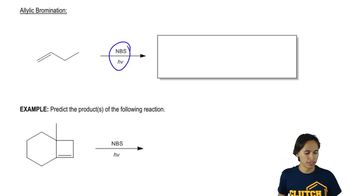
Allylic Bromination

Allylic bromination is a type of radical substitution reaction where a bromine atom is introduced at the allylic position of an alkene. This position is adjacent to the double bond, and the reaction typically involves the use of N-bromosuccinimide (NBS) in the presence of light or heat to generate bromine radicals that facilitate the substitution.
추천 영상:
00:54
Mechanism of Allylic Bromination.

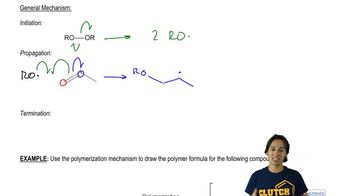
Radical Mechanism

The radical mechanism is crucial for understanding allylic bromination. It involves the formation of a bromine radical, which abstracts a hydrogen atom from the allylic position, creating an allylic radical. This radical then reacts with another bromine molecule to form the brominated product. The stability of the allylic radical is key to predicting the major product.
추천 영상:
03:28
The mechanism of Radical Polymerization.

Regioselectivity in Allylic Bromination

Regioselectivity refers to the preference for the formation of one constitutional isomer over others in a chemical reaction. In allylic bromination, the most stable allylic radical is formed preferentially, leading to the major product. Factors such as resonance stabilization and steric effects influence which allylic position is brominated, guiding the prediction of the major product.
추천 영상:
00:54
Mechanism of Allylic Bromination.