Ch. 11 - Properties and Synthesis of Alkyl Halides: Radical Reactions
Mullins - Organic Chemistry: A Learner Centered Approach 1st Edition
Mullins1st EditionOrganic Chemistry: A Learner Centered ApproachISBN: 9780137566471당신이 사용하는 게 아니라요?교과서 변경
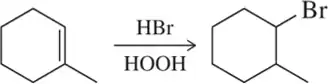
10장, 문제 48b

Suggest a mechanism for the following reactions.
(b) Chemical reaction showing cyclohexene reacting with HBr and HOOH to form bromocyclohexane via anti-Markovnikov addition.

검증된 단계별 안내
1
Identify the type of reaction: Determine if the reaction is an addition, elimination, substitution, or rearrangement. This will guide the mechanism you propose.
Analyze the reactants and products: Look at the functional groups present in the reactants and products. This will help you understand what transformations are occurring.
Determine the key intermediates: Consider any carbocations, carbanions, radicals, or other intermediates that might form during the reaction. These are often crucial for understanding the mechanism.
Propose the step-by-step mechanism: Start with the initial reactants and show how they transform into intermediates and then into products. Use curved arrows to indicate the movement of electrons.
Consider stereochemistry and regiochemistry: If applicable, think about how the reaction might affect the stereochemistry or regiochemistry of the molecules involved. This can be important for understanding the full mechanism.

비슷한 문제에 대한 검증된 영상 답변:

이 영상 해법은 위 문제에 도움이 된다고 튜터들이 추천한 것입니다.
영상 길이:
9m

주요 개념

질문에 올바르게 답하기 위해 반드시 이해해야 하는 핵심 개념들은 다음과 같습니다.

Reaction Mechanism

A reaction mechanism is a detailed step-by-step description of how a chemical reaction occurs at the molecular level. It includes the sequence of elementary steps, the movement of electrons, and the formation and breaking of bonds. Understanding mechanisms helps predict the products and intermediates formed during the reaction.
추천 영상:
02:16
Heck Reaction Mechanism

Electrophiles and Nucleophiles

Electrophiles are species that seek electrons and are typically positively charged or electron-deficient, while nucleophiles are electron-rich species that donate electrons. Identifying electrophiles and nucleophiles in a reaction is crucial for understanding how reactants interact and form products, as they dictate the direction and nature of the electron flow.
추천 영상:
03:
Nucleophile or Electrophile

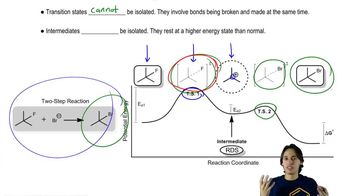
Transition States and Intermediates

Transition states are high-energy states that occur during the conversion of reactants to products, representing the point of maximum energy along the reaction path. Intermediates are species formed between reactants and products that are often short-lived. Recognizing these helps in mapping out the energy profile and stability of the reaction pathway.
추천 영상:
06:55
Intermediates vs. Transition States