Ch. 11 - Properties and Synthesis of Alkyl Halides: Radical Reactions
Mullins - Organic Chemistry: A Learner Centered Approach 1st Edition
Mullins1st EditionOrganic Chemistry: A Learner Centered ApproachISBN: 9780137566471당신이 사용하는 게 아니라요?교과서 변경
10장, 문제 10c

Predict the product of the following haloalkane syntheses.
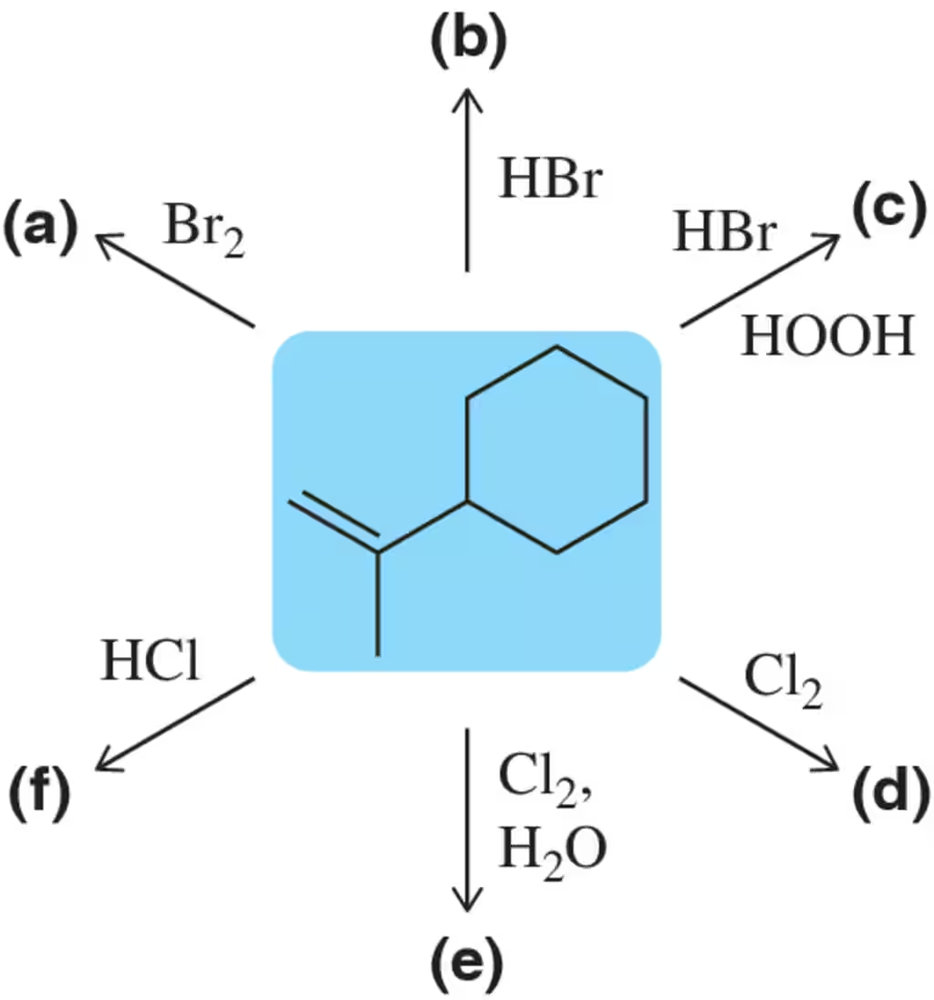
Chemical reaction diagram with a cyclohexane derivative and reagents: Br2, HBr, HBr/HO, Cl2, Cl2/H2O, HCl.
(c) HBr↗HOOH

검증된 단계별 안내
1
Identify the type of reaction: The presence of HBr and HOOH suggests a radical addition reaction, specifically anti-Markovnikov addition due to the presence of peroxide (HOOH).
Understand the mechanism: In the presence of peroxides, HBr undergoes a radical chain mechanism. The peroxide initiates the formation of bromine radicals.
Determine the regioselectivity: Anti-Markovnikov addition occurs because the bromine radical adds to the less substituted carbon of the alkene, leading to the formation of the more stable radical intermediate.
Predict the product: The bromine radical adds to the less substituted carbon, and the hydrogen from HBr adds to the more substituted carbon, resulting in the formation of a haloalkane.
Consider stereochemistry: Radical reactions often lead to racemic mixtures if the product has chiral centers, due to the planar nature of the radical intermediate.

비슷한 문제에 대한 검증된 영상 답변:

이 영상 해법은 위 문제에 도움이 된다고 튜터들이 추천한 것입니다.
영상 길이:
44s

주요 개념

질문에 올바르게 답하기 위해 반드시 이해해야 하는 핵심 개념들은 다음과 같습니다.

Haloalkane Synthesis

Haloalkane synthesis involves the formation of alkyl halides through the reaction of alkanes with halogens. In this context, the reaction typically proceeds via a radical mechanism, where the halogen atom replaces a hydrogen atom in the alkane, resulting in the formation of a haloalkane.
추천 영상:
가이드 코스
1:16
Synthesis of Amino Acids: Strecker Synthesis Example 1

Peroxide Effect

The peroxide effect, also known as the anti-Markovnikov addition, occurs when peroxides are present in the reaction of alkenes with hydrogen halides. This effect leads to the addition of the halogen to the less substituted carbon atom, contrary to the usual Markovnikov rule, due to the formation of free radicals initiated by the peroxide.
추천 영상:
가이드 코스
2:02
Directing Effects in Substituted Pyrroles, Furans, and Thiophenes Concept 1

Radical Mechanism

A radical mechanism involves the formation and reaction of free radicals, which are highly reactive species with unpaired electrons. In the presence of peroxides, the reaction of HBr with alkenes proceeds via a radical chain mechanism, where the peroxide initiates the formation of bromine radicals, leading to the anti-Markovnikov addition of HBr.
추천 영상:
03:28
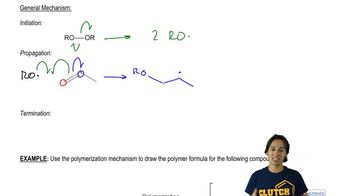
The mechanism of Radical Polymerization.