Ch. 11 - Properties and Synthesis of Alkyl Halides: Radical Reactions
Mullins - Organic Chemistry: A Learner Centered Approach 1st Edition
Mullins1st EditionOrganic Chemistry: A Learner Centered ApproachISBN: 9780137566471당신이 사용하는 게 아니라요?교과서 변경
10장, 문제 49

The following haloalkanes can all be prepared starting from the same alkene. Give the alkene and the reagents needed for each.
Four haloalkanes with arrows pointing to a central box with a question mark, indicating a common alkene precursor.

검증된 단계별 안내
1
Identify the haloalkanes given in the problem. Haloalkanes are organic compounds containing halogens (such as Cl, Br, I) attached to an alkane chain.
Determine the structure of the alkene that can serve as a precursor to these haloalkanes. Consider the position of the halogen in the haloalkanes to deduce the possible structure of the alkene.
Recall the addition reactions of alkenes with halogens or hydrogen halides. These reactions typically involve the electrophilic addition mechanism, where the alkene reacts with a halogen or hydrogen halide to form a haloalkane.
For each haloalkane, identify the specific reagent needed. For example, if the haloalkane is a chloroalkane, the reagent could be HCl or Cl₂. If it's a bromoalkane, the reagent could be HBr or Br₂.
Write the chemical equations for each reaction, showing the conversion of the alkene to the haloalkane using the identified reagents. Use MathML to represent the chemical structures and equations clearly.

비슷한 문제에 대한 검증된 영상 답변:

이 영상 해법은 위 문제에 도움이 된다고 튜터들이 추천한 것입니다.
영상 길이:
1m

주요 개념

질문에 올바르게 답하기 위해 반드시 이해해야 하는 핵심 개념들은 다음과 같습니다.

Alkene Structure

Alkenes are hydrocarbons containing a carbon-carbon double bond, which is the site of reactivity in many organic reactions. Understanding the structure of alkenes, including the position and geometry of the double bond, is crucial for predicting the products of reactions involving alkenes.
추천 영상:
가이드 코스
1:59
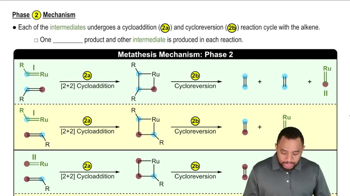
Alkene Metathesis Concept 5

Electrophilic Addition Reactions

Electrophilic addition is a key reaction mechanism for alkenes, where the double bond acts as a nucleophile and reacts with electrophiles. This mechanism is essential for converting alkenes into haloalkanes, as it involves the addition of halogens or hydrogen halides across the double bond.
추천 영상:
05:39
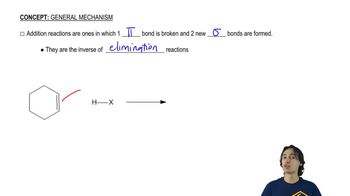
Features of Addition Mechanisms.

Regioselectivity and Markovnikov's Rule

Regioselectivity refers to the preference for the formation of one constitutional isomer over another in a chemical reaction. Markovnikov's Rule predicts that in the addition of HX to an alkene, the hydrogen atom will attach to the carbon with more hydrogen substituents, while the halide will attach to the carbon with fewer hydrogen substituents, guiding the formation of specific haloalkanes.
추천 영상:
03:54
The 18 and 16 Electron Rule