Ch. 12 - Substitution and Elimination: Reactions of Haloalkanes
Mullins - Organic Chemistry: A Learner Centered Approach 1st Edition
Mullins1st EditionOrganic Chemistry: A Learner Centered ApproachISBN: 9780137566471당신이 사용하는 게 아니라요?교과서 변경
11장, 문제 50e

For which of the following reactions would you expect elimination to be more favored than substitution?
(e)

검증된 단계별 안내
1
Step 1: Analyze the reaction conditions for each case. The first reaction uses NaSCH₃ in DMSO, which is a strong nucleophile and a polar aprotic solvent. The second reaction uses NaOEt in EtOH, which is a strong base and a polar protic solvent.
Step 2: Understand the role of the solvent. Polar aprotic solvents like DMSO favor substitution reactions (S_N2 mechanism) because they stabilize the transition state without stabilizing the nucleophile. Polar protic solvents like EtOH favor elimination reactions (E2 mechanism) because they stabilize the base and promote proton abstraction.
Step 3: Consider the nucleophile/base. NaSCH₃ is a strong nucleophile but a weak base, favoring substitution over elimination. NaOEt is both a strong nucleophile and a strong base, favoring elimination over substitution.
Step 4: Evaluate the structure of the substrate. Both substrates are secondary alkyl halides, which can undergo either substitution or elimination. However, elimination is more likely when a strong base is present, as in the second reaction.
Step 5: Conclude that elimination is more favored in the second reaction (NaOEt/EtOH) due to the combination of a strong base and polar protic solvent, which promotes the E2 mechanism.

비슷한 문제에 대한 검증된 영상 답변:

이 영상 해법은 위 문제에 도움이 된다고 튜터들이 추천한 것입니다.
영상 길이:
4m

주요 개념

질문에 올바르게 답하기 위해 반드시 이해해야 하는 핵심 개념들은 다음과 같습니다.

Elimination vs. Substitution Reactions

In organic chemistry, elimination reactions involve the removal of atoms or groups from a molecule, resulting in the formation of a double bond or a ring structure. In contrast, substitution reactions replace one atom or group with another. The preference for elimination over substitution often depends on factors such as the structure of the substrate, the nature of the leaving group, and the reaction conditions.
추천 영상:
00:38
Intro to Substitution/Elimination Problems

Solvent Effects

The choice of solvent can significantly influence the outcome of a reaction. Polar aprotic solvents, like DMSO, favor elimination reactions by stabilizing the transition state and promoting the formation of alkenes. Conversely, polar protic solvents, such as ethanol, tend to stabilize carbocations, which can lead to substitution reactions. Understanding solvent effects is crucial for predicting reaction pathways.
추천 영상:
01:16
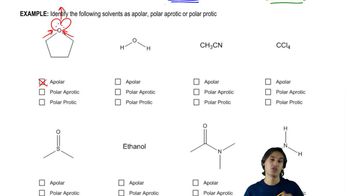
Identification of polarity in solvents

Nucleophilicity and Basicity

Nucleophilicity refers to the ability of a species to donate an electron pair to form a bond, while basicity measures the tendency of a species to accept protons. Strong bases are typically better nucleophiles and favor elimination reactions, especially in the presence of a good leaving group. In the given reactions, the nucleophiles (NaSCH3 and NaOEt) differ in their basicity, influencing whether elimination or substitution is favored.
추천 영상:
06:21
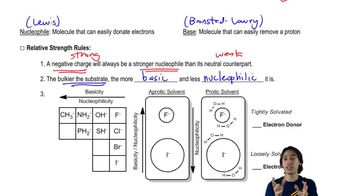
Understanding the difference between basicity and nucleophilicity.