Ch. 12 - Substitution and Elimination: Reactions of Haloalkanes
Mullins - Organic Chemistry: A Learner Centered Approach 1st Edition
Mullins1st EditionOrganic Chemistry: A Learner Centered ApproachISBN: 9780137566471당신이 사용하는 게 아니라요?교과서 변경
11장, 문제 51d

Predict the product of the following reactions.
(d)

검증된 단계별 안내
1
Step 1: Analyze the structure of the reactant. The molecule contains an iodine atom attached to a secondary carbon, which makes it a good leaving group. The presence of a bulky base, NaO-tBu (sodium tert-butoxide), suggests that the reaction will likely proceed via an E2 elimination mechanism.
Step 2: Consider the stereochemistry of the molecule. In an E2 elimination, the hydrogen to be removed must be anti-periplanar to the leaving group (iodine). Identify the β-hydrogens on the adjacent carbons and determine which hydrogen is anti-periplanar to the iodine.
Step 3: Predict the major product based on Zaitsev's rule. Zaitsev's rule states that the most substituted alkene will be the major product in an elimination reaction. However, due to the bulky base (NaO-tBu), the reaction may favor the formation of the less substituted alkene (Hofmann product). Consider steric hindrance in the elimination process.
Step 4: Draw the possible alkenes formed from the elimination reaction. Remove the iodine and the anti-periplanar β-hydrogen, forming a double bond between the α-carbon (where iodine was attached) and the β-carbon.
Step 5: Determine the major product based on the steric effects of the bulky base. The bulky base will favor the formation of the less substituted alkene, which is the Hofmann product. Ensure the stereochemistry of the product aligns with the anti-periplanar requirement of the E2 mechanism.

비슷한 문제에 대한 검증된 영상 답변:

이 영상 해법은 위 문제에 도움이 된다고 튜터들이 추천한 것입니다.
영상 길이:
3m

주요 개념

질문에 올바르게 답하기 위해 반드시 이해해야 하는 핵심 개념들은 다음과 같습니다.

Nucleophilic Substitution Reactions

Nucleophilic substitution reactions involve the replacement of a leaving group (like iodine) by a nucleophile. In this case, sodium tert-butoxide (NaO-t-Bu) acts as a strong nucleophile, attacking the carbon atom bonded to the iodine. Understanding the mechanism, whether it follows an SN1 or SN2 pathway, is crucial for predicting the product.
추천 영상:
01:47
Nucleophiles and Electrophiles can react in Substitution Reactions.

Elimination Reactions

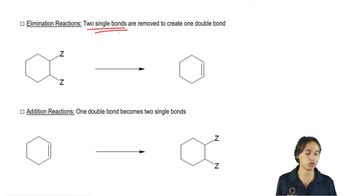
Elimination reactions involve the removal of a small molecule (like H-I) from a larger molecule, resulting in the formation of a double bond. In the presence of a strong base like NaO-t-Bu, the reaction can lead to the formation of alkenes through either E1 or E2 mechanisms. Recognizing the conditions that favor elimination over substitution is essential for predicting the outcome.
추천 영상:
00:40
Recognizing Elimination Reactions.

Regioselectivity and Stereochemistry

Regioselectivity refers to the preference of a chemical reaction to yield one structural isomer over others. In this reaction, the formation of the double bond can lead to different alkene products depending on the site of elimination. Additionally, stereochemistry plays a role in determining the configuration of the double bond, which can affect the stability and reactivity of the product.
추천 영상:
가이드 코스
1:38
Polymer Stereochemistry Concept 1