Ch. 12 - Substitution and Elimination: Reactions of Haloalkanes
Mullins - Organic Chemistry: A Learner Centered Approach 1st Edition
Mullins1st EditionOrganic Chemistry: A Learner Centered ApproachISBN: 9780137566471당신이 사용하는 게 아니라요?교과서 변경
11장, 문제 38b

Practice your electron-pushing skills by drawing a mechanism for the following E1 reactions.
(b) 

검증된 단계별 안내
1
Step 1: Identify the reaction type. This is an E1 elimination reaction, which proceeds via a two-step mechanism involving the formation of a carbocation intermediate.
Step 2: Analyze the substrate. The starting molecule contains an iodine atom as the leaving group attached to a carbon. The reaction occurs in the presence of an alcohol solvent, which can act as a weak base.
Step 3: First step of the mechanism: The iodine atom leaves, forming a carbocation intermediate. This is the rate-determining step. Use curved arrows to show the bond between the carbon and iodine breaking, with the electrons moving to iodine.
Step 4: Second step of the mechanism: A proton is removed from a β-carbon (adjacent to the carbocation) by the alcohol solvent, leading to the formation of a double bond. Use curved arrows to show the movement of electrons from the β-carbon-hydrogen bond to form the π bond in the alkene.
Step 5: Verify the product. The final product is an alkene with the double bond formed between the α-carbon (originally bonded to iodine) and the β-carbon. Ensure the stereochemistry and connectivity of the product match the given structure.

비슷한 문제에 대한 검증된 영상 답변:

이 영상 해법은 위 문제에 도움이 된다고 튜터들이 추천한 것입니다.

주요 개념

질문에 올바르게 답하기 위해 반드시 이해해야 하는 핵심 개념들은 다음과 같습니다.

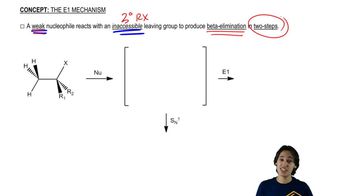
E1 Reaction Mechanism

The E1 (unimolecular elimination) reaction is a two-step mechanism where the first step involves the formation of a carbocation intermediate after the leaving group departs. This is followed by the elimination of a proton to form a double bond. Understanding this mechanism is crucial for predicting the products of the reaction and the stability of the intermediates involved.
추천 영상:
08:09
Drawing the E1 Mechanism.

Carbocation Stability

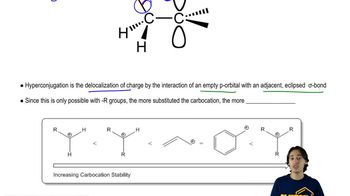
Carbocation stability is a key factor in E1 reactions, as more stable carbocations will form more readily. Stability is influenced by factors such as the degree of substitution (tertiary > secondary > primary) and resonance effects. Recognizing the stability of the carbocation formed in the reaction helps in determining the likelihood of the reaction proceeding and the major products formed.
추천 영상:
05:58
Determining Carbocation Stability

Electron-Pushing Mechanism

The electron-pushing mechanism, often illustrated using curved arrows, represents the movement of electrons during chemical reactions. In E1 reactions, arrows are used to show the departure of the leaving group and the formation of the double bond. Mastery of this technique is essential for accurately depicting reaction mechanisms and understanding the flow of electrons in organic reactions.
추천 영상:
03:54
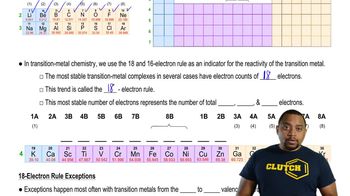
The 18 and 16 Electron Rule