Ch. 12 - Substitution and Elimination: Reactions of Haloalkanes
Mullins - Organic Chemistry: A Learner Centered Approach 1st Edition
Mullins1st EditionOrganic Chemistry: A Learner Centered ApproachISBN: 9780137566471당신이 사용하는 게 아니라요?교과서 변경
11장, 문제 39a

Would you expect the following bases to favor E1 or E2 elimination?
(a) Chemical structure of a branched alcohol with a hydroxyl group (OH) attached, relevant to elimination reactions.

검증된 단계별 안내
1
Step 1: Understand the difference between E1 and E2 elimination mechanisms. E1 elimination is a two-step process involving the formation of a carbocation intermediate, while E2 elimination is a one-step process where the base abstracts a proton and the leaving group departs simultaneously.
Step 2: Analyze the strength of the base. Strong bases typically favor E2 elimination because they can efficiently abstract a proton in a single step. Weak bases, on the other hand, are more likely to favor E1 elimination as they do not have the strength to directly abstract a proton.
Step 3: Consider the substrate structure. E1 elimination is favored by substrates that can form stable carbocations (e.g., tertiary carbons or allylic/benzylic carbons). E2 elimination is less dependent on carbocation stability and can occur with primary, secondary, or tertiary substrates.
Step 4: Evaluate steric hindrance. Bulky bases are more likely to favor E2 elimination because steric hindrance makes it difficult for them to approach the substrate closely enough to facilitate carbocation formation, which is required for E1.
Step 5: Examine reaction conditions. E1 elimination is typically favored under conditions that promote carbocation formation, such as polar protic solvents and heat. E2 elimination is favored under conditions that support strong base activity, such as polar aprotic solvents.

비슷한 문제에 대한 검증된 영상 답변:

이 영상 해법은 위 문제에 도움이 된다고 튜터들이 추천한 것입니다.

주요 개념

질문에 올바르게 답하기 위해 반드시 이해해야 하는 핵심 개념들은 다음과 같습니다.

E1 and E2 Mechanisms

E1 (unimolecular elimination) and E2 (bimolecular elimination) are two types of elimination reactions in organic chemistry. E1 involves a two-step mechanism where the leaving group departs first, forming a carbocation, followed by deprotonation to form the alkene. In contrast, E2 is a one-step mechanism where the base abstracts a proton while the leaving group departs simultaneously, leading to the formation of the alkene.
추천 영상:
09:36
Drawing the E2 Mechanism.

Base Strength and Sterics

The strength and steric hindrance of the base play a crucial role in determining whether an E1 or E2 mechanism will be favored. Strong bases, such as alkoxides, typically favor E2 reactions due to their ability to abstract protons quickly. Conversely, weak bases or those that are sterically hindered may lead to E1 reactions, as they are less effective at deprotonation and may allow for carbocation formation.
추천 영상:
02:53
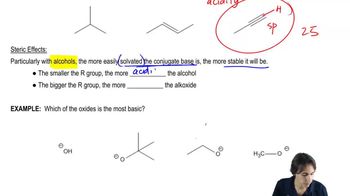
Understanding steric effects.

Substrate Structure

The structure of the substrate, particularly the degree of substitution at the carbon bearing the leaving group, influences the preference for E1 or E2 mechanisms. Tertiary substrates favor E1 due to the stability of the resulting carbocation, while primary substrates are more likely to undergo E2 elimination, as they do not stabilize carbocations effectively. Secondary substrates can lead to both mechanisms depending on the conditions.
추천 영상:
03:04
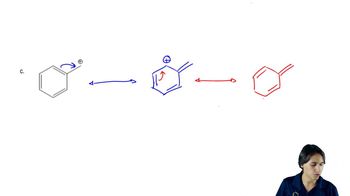
Drawing Resonance Structures