Ch. 12 - Substitution and Elimination: Reactions of Haloalkanes
Mullins - Organic Chemistry: A Learner Centered Approach 1st Edition
Mullins1st EditionOrganic Chemistry: A Learner Centered ApproachISBN: 9780137566471당신이 사용하는 게 아니라요?교과서 변경
11장, 문제 52b

Suggest a mechanism for the following substitution reactions.
(b) Chemical structure showing a chlorine atom and a hydrogen atom on a cyclohexane ring reacting with methanol to form an ether.

검증된 단계별 안내
1
Analyze the type of substitution reaction: Determine whether the reaction is likely to proceed via an SN1 or SN2 mechanism. This depends on factors such as the structure of the substrate (primary, secondary, or tertiary carbon), the strength of the nucleophile, the solvent, and the leaving group.
Identify the substrate and classify it: Examine the carbon atom attached to the leaving group. If it is tertiary, the reaction is more likely to proceed via an SN1 mechanism. If it is primary or secondary, consider an SN2 mechanism unless steric hindrance or other factors favor SN1.
Examine the nucleophile: If the nucleophile is strong (e.g., negatively charged or highly reactive), an SN2 mechanism is more likely. If the nucleophile is weak (e.g., neutral or less reactive), an SN1 mechanism is more likely.
Propose the mechanism: For an SN1 reaction, describe the two-step process: (1) the leaving group departs, forming a carbocation intermediate, and (2) the nucleophile attacks the carbocation. For an SN2 reaction, describe the one-step concerted mechanism where the nucleophile attacks the electrophilic carbon from the opposite side of the leaving group, leading to inversion of configuration.
Draw the reaction pathway: Illustrate the key intermediates and transition states for the proposed mechanism. For SN1, include the carbocation intermediate and any potential rearrangements. For SN2, show the backside attack and the transition state where the nucleophile and leaving group are partially bonded to the carbon.

비슷한 문제에 대한 검증된 영상 답변:

이 영상 해법은 위 문제에 도움이 된다고 튜터들이 추천한 것입니다.
영상 길이:
6m

주요 개념

질문에 올바르게 답하기 위해 반드시 이해해야 하는 핵심 개념들은 다음과 같습니다.

Nucleophilic Substitution Mechanisms

Nucleophilic substitution reactions involve the replacement of a leaving group in a molecule by a nucleophile. The two primary mechanisms are SN1 and SN2. SN1 is a two-step process where the leaving group departs first, forming a carbocation, followed by nucleophilic attack. In contrast, SN2 is a one-step process where the nucleophile attacks the substrate simultaneously as the leaving group departs, leading to a concerted reaction.
추천 영상:
01:47
Nucleophiles and Electrophiles can react in Substitution Reactions.

Leaving Groups

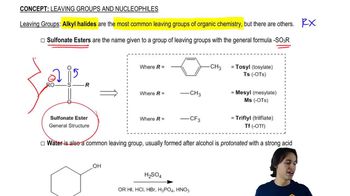
A leaving group is an atom or group that can depart from the parent molecule during a substitution reaction. Good leaving groups are typically stable after departure, such as halides (Cl, Br, I) or sulfonate groups (like tosylate). The ability of a leaving group to stabilize its negative charge or form a stable molecule is crucial for the reaction's feasibility and rate.
추천 영상:
07:22
The 3 important leaving groups to know.

Nucleophiles

Nucleophiles are species that donate an electron pair to form a new bond during a substitution reaction. They can be negatively charged ions (like OH⁻ or CN⁻) or neutral molecules with lone pairs (like water or ammonia). The strength and reactivity of a nucleophile depend on its charge, electronegativity, and steric hindrance, influencing the reaction pathway and rate.
추천 영상:
08:27
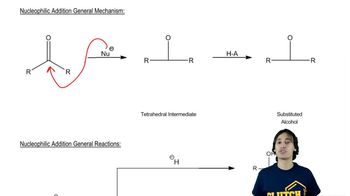
Nucleophilic Addition