

Ch. 12 - Substitution and Elimination: Reactions of Haloalkanes
Mullins - Organic Chemistry: A Learner Centered Approach 1st Edition
Mullins1st EditionOrganic Chemistry: A Learner Centered ApproachISBN: 9780137566471당신이 사용하는 게 아니라요?교과서 변경
11장, 문제 71

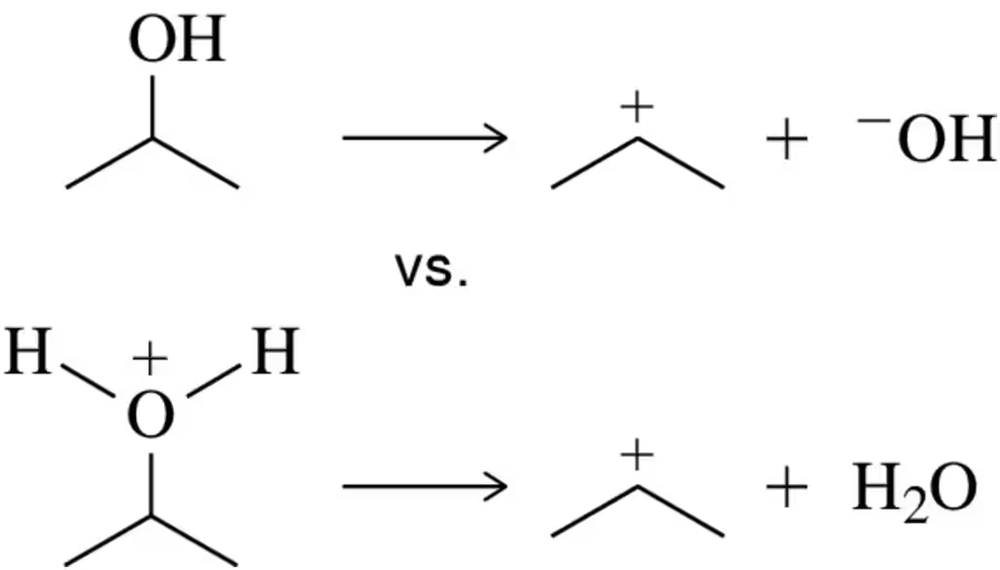
Which is a better leaving group, HO⁻ or H2O? Explain your answer.
Comparison of HO⁻ and H₂O as leaving groups in substitution reactions, showing reaction pathways and products.

검증된 단계별 안내
1
Step 1: Understand the concept of a leaving group. A leaving group is an atom or group of atoms that can detach from the parent molecule during a chemical reaction, typically in substitution or elimination reactions. A good leaving group is stable after it leaves, often as a neutral molecule or a weak base.
Step 2: Compare the stability of HO⁻ (hydroxide ion) and H₂O (water) after they leave. HO⁻ is a negatively charged ion, while H₂O is a neutral molecule. Neutral molecules are generally more stable than charged species, making H₂O more stable than HO⁻.
Step 3: Consider the basicity of the leaving groups. HO⁻ is a strong base, meaning it is less stable and more reactive. H₂O, on the other hand, is a weak base and more stable. Weak bases tend to be better leaving groups because they are less likely to react after leaving.
Step 4: Evaluate the role of solvation and stabilization. In a polar solvent, H₂O can be further stabilized due to hydrogen bonding and dipole interactions, whereas HO⁻, being charged, may experience less stabilization compared to the neutral H₂O.
Step 5: Conclude that H₂O is a better leaving group than HO⁻ because it is neutral, more stable, and less basic, making it more favorable for detachment in a chemical reaction.

비슷한 문제에 대한 검증된 영상 답변:

이 영상 해법은 위 문제에 도움이 된다고 튜터들이 추천한 것입니다.
영상 길이:
3m

주요 개념

질문에 올바르게 답하기 위해 반드시 이해해야 하는 핵심 개념들은 다음과 같습니다.

Leaving Groups

Leaving groups are atoms or groups of atoms that can depart from a molecule during a chemical reaction, typically in nucleophilic substitution or elimination reactions. A good leaving group is one that can stabilize the negative charge or is able to exist stably in solution after leaving. The ability of a leaving group to depart is influenced by its bond strength and the stability of the resulting species.
추천 영상:
07:22
The 3 important leaving groups to know.

Basicity and Leaving Group Ability

The basicity of a leaving group is inversely related to its ability to leave. Strong bases, like HO⁻ (hydroxide ion), are poor leaving groups because they are unstable and highly reactive in solution. In contrast, weaker bases, such as H₂O (water), are better leaving groups because they can stabilize the negative charge more effectively after departure, making them more favorable in substitution reactions.
추천 영상:
03:06
How to use the factors affecting acidity to predict leaving group ability.

Stability of Leaving Groups

The stability of a leaving group after it departs is crucial in determining its effectiveness. Water (H₂O) is a stable molecule that can exist freely in solution, while hydroxide (HO⁻) is a highly reactive ion. The stability of the leaving group influences the reaction's kinetics and thermodynamics, with more stable leaving groups facilitating faster and more favorable reactions.
추천 영상:
07:22
The 3 important leaving groups to know.