Ch. 12 - Substitution and Elimination: Reactions of Haloalkanes
Mullins - Organic Chemistry: A Learner Centered Approach 1st Edition
Mullins1st EditionOrganic Chemistry: A Learner Centered ApproachISBN: 9780137566471당신이 사용하는 게 아니라요?교과서 변경
11장, 문제 68

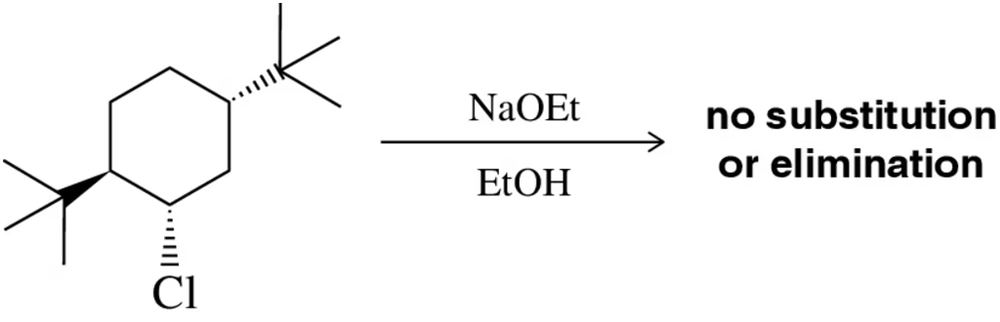
The following chlorocyclohexane undergoes neither Sₙ2 nor E2 under the conditions shown. Why?
Chlorocyclohexane structure with NaOEt and EtOH, indicating no substitution or elimination reactions occur.

검증된 단계별 안내
1
Analyze the structure of chlorocyclohexane: Chlorocyclohexane is a cyclohexane ring with a chlorine atom attached to one of the carbons. The chlorine atom is a good leaving group, but the reaction mechanism depends on the conditions provided.
Understand the Sₙ2 mechanism: The Sₙ2 mechanism requires a strong nucleophile and a substrate that is not sterically hindered. In the case of chlorocyclohexane, the cyclohexane ring creates steric hindrance, especially if the chlorine is in the equatorial position, making it difficult for the nucleophile to attack the carbon bearing the chlorine.
Understand the E2 mechanism: The E2 mechanism requires a strong base and an anti-periplanar arrangement of the β-hydrogen and the leaving group. In chlorocyclohexane, the anti-periplanar geometry may not be achievable due to the conformational constraints of the cyclohexane ring, especially if the chlorine is in the equatorial position.
Consider the reaction conditions: If the conditions provided do not include a strong nucleophile (for Sₙ2) or a strong base (for E2), neither mechanism will proceed. Additionally, steric hindrance and conformational constraints further inhibit these reactions.
Conclude why neither mechanism occurs: The combination of steric hindrance, conformational constraints, and potentially unsuitable reaction conditions prevents both the Sₙ2 and E2 mechanisms from occurring in this case.

비슷한 문제에 대한 검증된 영상 답변:

이 영상 해법은 위 문제에 도움이 된다고 튜터들이 추천한 것입니다.
영상 길이:
8m

주요 개념

질문에 올바르게 답하기 위해 반드시 이해해야 하는 핵심 개념들은 다음과 같습니다.

Sₙ2 Mechanism

The Sₙ2 mechanism is a bimolecular nucleophilic substitution reaction where a nucleophile attacks an electrophile, leading to the simultaneous displacement of a leaving group. This reaction typically occurs in primary or secondary substrates due to steric accessibility. In the case of chlorocyclohexane, steric hindrance from the cyclohexane ring can prevent effective nucleophilic attack, making Sₙ2 unlikely.
추천 영상:
04:32
General Mechanism

E2 Mechanism

The E2 mechanism is a concerted elimination reaction where a base abstracts a proton while a leaving group departs, resulting in the formation of a double bond. This reaction is favored in secondary and tertiary substrates due to steric factors. In chlorocyclohexane, the ring structure may hinder the necessary anti-periplanar arrangement of the leaving group and the hydrogen, thus inhibiting E2 reactivity.
추천 영상:
09:36
Drawing the E2 Mechanism.

Steric Hindrance

Steric hindrance refers to the prevention of chemical reactions due to the spatial arrangement of atoms within a molecule. In bulky molecules like chlorocyclohexane, the presence of large groups can obstruct the approach of nucleophiles or bases, making reactions like Sₙ2 and E2 less favorable. Understanding steric hindrance is crucial for predicting the reactivity of organic compounds.
추천 영상:
02:53
Understanding steric effects.