Ch. 13 - Alcohols, Ethers and Related Compounds: Substitution and Elimination
Mullins - Organic Chemistry: A Learner Centered Approach 1st Edition
Mullins1st EditionOrganic Chemistry: A Learner Centered ApproachISBN: 9780137566471당신이 사용하는 게 아니라요?교과서 변경
12장, 문제 13c

Predict the product of each of the following alcohol synthesis reactions.
(c)

검증된 단계별 안내
1
Identify the type of reaction: The presence of LiOH and H2O suggests a nucleophilic substitution reaction, where the hydroxide ion (OH-) acts as the nucleophile.
Analyze the substrate: The substrate is a secondary alkyl chloride, which is prone to undergo SN2 reactions due to the presence of a good leaving group (Cl-).
Consider the mechanism: In an SN2 reaction, the nucleophile attacks the electrophilic carbon from the opposite side of the leaving group, leading to the inversion of configuration at the carbon center.
Predict the product: The hydroxide ion will replace the chlorine atom, resulting in the formation of an alcohol. The structure will have an OH group where the Cl was originally located.
Verify stereochemistry: Since SN2 reactions involve inversion of configuration, ensure that the stereochemistry of the product reflects this change, if applicable.

비슷한 문제에 대한 검증된 영상 답변:

이 영상 해법은 위 문제에 도움이 된다고 튜터들이 추천한 것입니다.
영상 길이:
1m

주요 개념

질문에 올바르게 답하기 위해 반드시 이해해야 하는 핵심 개념들은 다음과 같습니다.

Alcohol Synthesis

Alcohol synthesis refers to the various chemical reactions and processes used to produce alcohols from different starting materials. This can include methods such as hydration of alkenes, reduction of carbonyl compounds, and substitution reactions. Understanding the mechanisms and conditions for these reactions is crucial for predicting the products formed.
추천 영상:
02:26
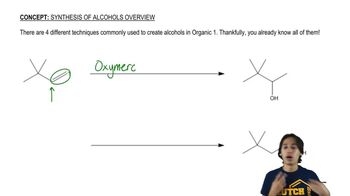
Forming alcohols through Oxymercuration-Reduction.

Reaction Mechanisms

A reaction mechanism is a step-by-step description of the pathway taken during a chemical reaction. It outlines the sequence of elementary steps, including bond breaking and forming, and the intermediates involved. Familiarity with common mechanisms, such as nucleophilic substitution or elimination, is essential for predicting the outcomes of alcohol synthesis reactions.
추천 영상:
02:16
Heck Reaction Mechanism

Functional Group Transformation

Functional group transformation involves the conversion of one functional group into another through chemical reactions. In the context of alcohol synthesis, this may include converting alkenes or carbonyls into alcohols. Recognizing how different functional groups can be interconverted is vital for understanding the products of synthesis reactions.
추천 영상:
02:36
Identifying Functional Groups