Ch. 13 - Alcohols, Ethers and Related Compounds: Substitution and Elimination
Mullins - Organic Chemistry: A Learner Centered Approach 1st Edition
Mullins1st EditionOrganic Chemistry: A Learner Centered ApproachISBN: 9780137566471당신이 사용하는 게 아니라요?교과서 변경
12장, 문제 12

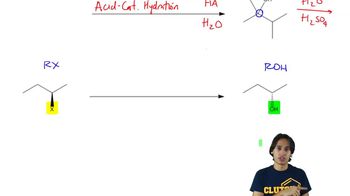
Show a mechanism for each of the alcohol synthesis reactions in Table 13.8.
<IMAGE>

검증된 단계별 안내
1
Identify the type of alcohol synthesis reaction in Table 13.8. Common methods include hydration of alkenes, reduction of carbonyl compounds, and substitution reactions involving alkyl halides.
For each reaction, determine the starting material and the reagents used. For example, hydration of an alkene typically involves an alkene and water in the presence of an acid catalyst, while reduction of a carbonyl compound may involve reagents like NaBH₄ or LiAlH₄.
Draw the mechanism for each reaction. For example, in the acid-catalyzed hydration of an alkene, the first step involves protonation of the alkene to form a carbocation intermediate. Then, water attacks the carbocation, followed by deprotonation to yield the alcohol.
For reduction reactions, such as the reduction of a ketone to a secondary alcohol, show the nucleophilic attack of the hydride ion (H⁻) on the carbonyl carbon, followed by protonation of the resulting alkoxide ion to form the alcohol.
Ensure that all intermediates, charges, and electron-pushing arrows are clearly shown in the mechanism for each reaction. Verify that the final product matches the alcohol described in Table 13.8.

비슷한 문제에 대한 검증된 영상 답변:

이 영상 해법은 위 문제에 도움이 된다고 튜터들이 추천한 것입니다.

주요 개념

질문에 올바르게 답하기 위해 반드시 이해해야 하는 핵심 개념들은 다음과 같습니다.

Alcohol Synthesis Reactions

Alcohol synthesis reactions involve the conversion of various organic compounds into alcohols through different chemical pathways. Common methods include the reduction of carbonyl compounds, hydration of alkenes, and nucleophilic substitution reactions. Understanding these pathways is crucial for predicting the products and mechanisms involved in alcohol formation.
추천 영상:
01:44
Forming alcohols through SN2 reactions.

Reaction Mechanisms

A reaction mechanism describes the step-by-step sequence of elementary reactions that occur during a chemical transformation. It provides insight into how reactants are converted into products, including the formation and breaking of bonds. Familiarity with mechanisms, such as nucleophilic attack and proton transfer, is essential for illustrating the synthesis of alcohols.
추천 영상:
02:16
Heck Reaction Mechanism

Functional Group Interconversion

Functional group interconversion refers to the transformation of one functional group into another within organic molecules. This concept is vital in organic synthesis, as it allows chemists to manipulate molecular structures to achieve desired compounds, such as converting alkenes or carbonyls into alcohols. Recognizing these transformations aids in understanding the overall synthesis process.
추천 영상:
02:36
Identifying Functional Groups