Ch. 16 - Metals in Organic Chemistry
Mullins - Organic Chemistry: A Learner Centered Approach 1st Edition
Mullins1st EditionOrganic Chemistry: A Learner Centered ApproachISBN: 9780137566471당신이 사용하는 게 아니라요?교과서 변경
15장, 문제 17

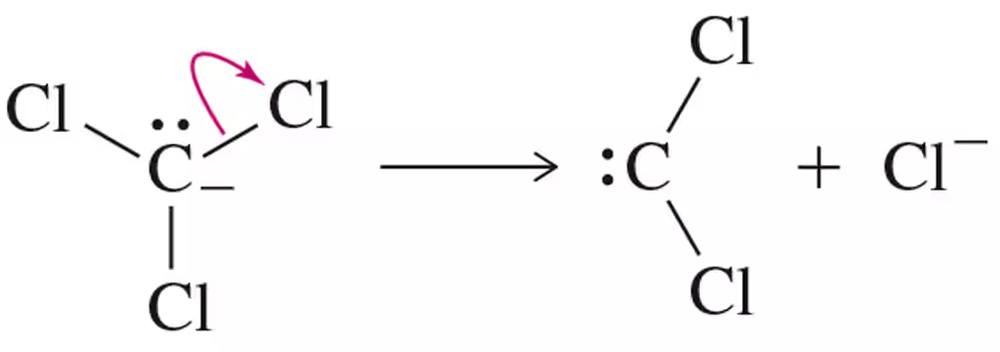
Estimate the value of entropy (∆S > 0 or ∆S < 0) for the elimination step shown.
Chemical reaction diagram showing chlorine atoms and a carbon atom, indicating an elimination step with entropy estimation.

검증된 단계별 안내
1
Step 1: Understand the concept of entropy (∆S). Entropy is a measure of disorder or randomness in a system. In chemical reactions, ∆S > 0 indicates an increase in disorder, while ∆S < 0 indicates a decrease in disorder.
Step 2: Analyze the elimination reaction. Elimination reactions typically involve the removal of atoms or groups from a molecule, resulting in the formation of a double bond and often the release of smaller molecules like H₂O or HCl.
Step 3: Consider the molecular changes during the elimination step. The reactant is usually a single, larger molecule, and the products are typically a smaller molecule (e.g., H₂O or HCl) and an unsaturated molecule (e.g., an alkene). This change generally increases the number of particles in the system.
Step 4: Evaluate the impact on entropy. The increase in the number of particles and the formation of a more disordered gaseous or liquid product typically leads to an increase in entropy (∆S > 0).
Step 5: Conclude based on the analysis. For elimination reactions, the entropy change is usually positive (∆S > 0) due to the increase in disorder and the number of particles in the system.

비슷한 문제에 대한 검증된 영상 답변:

이 영상 해법은 위 문제에 도움이 된다고 튜터들이 추천한 것입니다.
영상 길이:
1m

주요 개념

질문에 올바르게 답하기 위해 반드시 이해해야 하는 핵심 개념들은 다음과 같습니다.

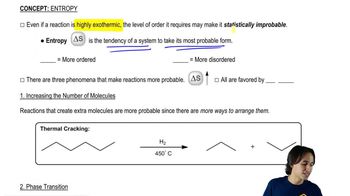
Entropy (S)

Entropy is a measure of the disorder or randomness in a system. In thermodynamics, it quantifies the number of possible arrangements of particles in a system. A positive change in entropy (∆S > 0) indicates an increase in disorder, while a negative change (∆S < 0) suggests a decrease in disorder. Understanding entropy is crucial for predicting the spontaneity of reactions.
추천 영상:
02:46
Explaining what entropy is.

Elimination Reactions

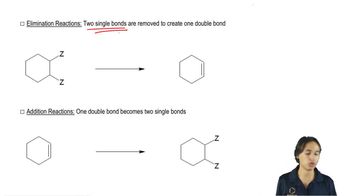
Elimination reactions are a type of organic reaction where two substituents are removed from a molecule, resulting in the formation of a double bond or a ring structure. These reactions often involve the loss of small molecules, such as water or hydrogen halides. The nature of the elimination process can significantly influence the entropy change, as the formation of gaseous products typically increases disorder.
추천 영상:
00:40
Recognizing Elimination Reactions.

Thermodynamic Favorability

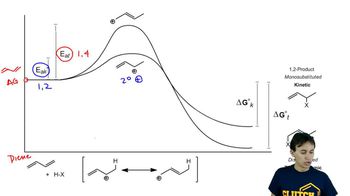
Thermodynamic favorability refers to the likelihood of a reaction occurring based on changes in enthalpy (∆H) and entropy (∆S). A reaction is considered thermodynamically favorable if the Gibbs free energy change (∆G) is negative, which can occur when the increase in entropy compensates for any unfavorable enthalpic changes. Evaluating the entropy change during the elimination step is essential for determining the overall favorability of the reaction.
추천 영상:
08:51
Kinetic vs. Thermodynamic Control