


Ch. 16 - Metals in Organic Chemistry
Mullins - Organic Chemistry: A Learner Centered Approach 1st Edition
Mullins1st EditionOrganic Chemistry: A Learner Centered ApproachISBN: 9780137566471당신이 사용하는 게 아니라요?교과서 변경
15장, 문제 12b

Predict the product of the following aldehyde and ketone addition reactions.
(b) Reaction scheme showing a bromobenzene compound undergoing nucleophilic addition with steps and reagents listed.

검증된 단계별 안내
1
Identify the functional groups present in the reactants. Aldehydes and ketones both contain a carbonyl group (C=O).
Determine the type of addition reaction. Aldehydes and ketones typically undergo nucleophilic addition reactions due to the electrophilic nature of the carbonyl carbon.
Identify the nucleophile in the reaction. Common nucleophiles include hydride ions (H-) from reducing agents or organometallic reagents like Grignard reagents (R-MgX).
Consider the mechanism of the reaction. The nucleophile will attack the electrophilic carbonyl carbon, leading to the formation of a tetrahedral intermediate.
Predict the final product. The addition of the nucleophile to the carbonyl group will result in the formation of an alcohol if the nucleophile is a hydride or an alkoxide if the nucleophile is an organometallic reagent.

비슷한 문제에 대한 검증된 영상 답변:

이 영상 해법은 위 문제에 도움이 된다고 튜터들이 추천한 것입니다.
영상 길이:
2m

주요 개념

질문에 올바르게 답하기 위해 반드시 이해해야 하는 핵심 개념들은 다음과 같습니다.

Aldol Condensation

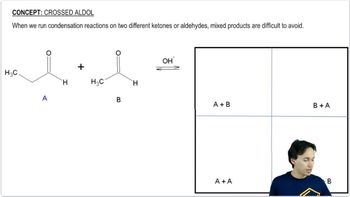
Aldol condensation is a reaction between aldehydes and ketones that involves the formation of a β-hydroxy aldehyde or ketone. This reaction occurs when an enolate ion, generated from a carbonyl compound, attacks another carbonyl carbon, leading to the formation of a new carbon-carbon bond. The product can further dehydrate to yield an α,β-unsaturated carbonyl compound.
추천 영상:
09:51
Crossed Aldol

Nucleophilic Addition

Nucleophilic addition is a fundamental reaction mechanism in organic chemistry where a nucleophile attacks an electrophilic carbon atom in a carbonyl group. This process is crucial in the formation of alcohols, aldehydes, and ketones. Understanding the reactivity of carbonyl compounds and the nature of nucleophiles is essential for predicting the products of reactions involving aldehydes and ketones.
추천 영상:
08:27
Nucleophilic Addition

Reaction Mechanism

A reaction mechanism is a step-by-step description of the pathway taken during a chemical reaction. It outlines the sequence of elementary steps, including bond breaking and forming, that lead to the final products. Analyzing the mechanism helps in predicting the products of reactions involving aldehydes and ketones, as it provides insight into the intermediates and transition states formed during the reaction.
추천 영상:
02:16
Heck Reaction Mechanism